Game Features
Home and Family
Characters can buy plots of land as small as a hut or tent, and build as large as an estate or castle, even a town. Complete "love quests" and meet a love interest; a humble peasant or a dominant scantily clad warrior. Raise children and create a family, with the player role-playing their destinies and fate. Make sure the family is safeguarded and assisted with workloads at home by collecting Companions and making friends with townsfolk. Retire and enjoy the home, continuing to play the character leisurely, or take over as one of the character's heirs. A character's home and family begin with their plot of land and partner and builds from there. Will it boast a luxurious wardrobe, an armory, a trophy room, an exquisite aquarium, stables and kennels on a farm with NPC farmhands, or a humble den carved in the face of the earth itself?
Turn Timer
Each player has 2 minutes to complete their turn once it begins. If the player does not act within this time, they forfeit their turn, and play passes to the next participant.
Turn Forfeit
Failing to act within the allotted time results in the loss of the current turn, ensuring gameplay remains swift and engaging.
Encounter Tokens
Encounter Tokens are used to define a fixed or randomly generated number of entries of an Encounter. For instance, there are 5 mob cards and a boss card; each mob card can be a value of x ≥ 1, either described on the card, directed in the module, or determined by the GM.
Example: The party has entered Queen Goblin's den, and she is accompanied by 1 steward, a jester, 4 goblin guardsmen and 6 scouts. There is only one Mob Card (see SORC Cards below) for each of them (so each has its own stats), but each card has a number of monster Tokens to represent the number of mobs, so there are 6 Tokens on the goblin scout Mob Card. Each time one is defeated, whether it's killed, runs, etc, the Token goes to the boneyard (see below). This same rule applies to anything, for example, the goblin den is also booby trapped x 12, so 12 †Encounter Tokens.
†This is why they're called Encounter Tokens and not just "mob tokens." See Mob, Boss and Mechanical Cards below.
The Boneyard
The boneyard is where passing Companions, broken gear, spent items and other Cards that are incapacitated for an indefinite amount of time go. Once resurrected, repaired or re-stocked respectively, the Cards go back to the table.
SORC Cards
Players use a comprehensive Card-based system to track their Abilities, Armaments, Companions and more. Mob Cards are often in groups and the amount of Mobs within any given group is represented by Tokens.
Each Box Set includes the essential SORC Cards for its respective module's level or rank, along with information such as stats, lore, and a ref # on each card. The ref # serves two purposes: it references the page in the module book where that card's content appears, and it is used to access the card's digital content online. Every SORC Card ref # follows this format: mod-ref#pg.12347291, the black portion is the page number in the module book where that card appears, and the green portion is the card's unique number. When accessing digital content online, only the green number is entered. Basic printable cut outs of SORC Cards are available at our website, along with a PDF lighter version of the game.
†Recipes are needed to craft items, so any item that can be crafted comes with a recipe and each recipe has instructions, life and a material list. Items that cannot be crafted can be discovered in the world. Every SORC Card NEEDED in a module to perform any talent, skill, or Trait comes with a basic Common punch out style SORC Card to ensure a seamless and enjoyable gaming experience.
Uncommon Cards are included in box sets as well, but Uncommon Cards are more Rare. For example: a player creates a Cleric that can begin their adventures proficient in all 1h blunt weapons, so the box set would have basic Common weapons, such as: 1h hammer and 1h mace, but a 1h flail, a bit stronger and maybe more exquisite, is less Common (Uncommon). The flail can still be retrieved, but not from every vendor in the game, it would need to be found.
Why Use SORC Cards?
SORC is a pretty crunchy game with a lot of elements and features, so the Cards make things more manageable. There are also a lot of elements in the game, including abilities, spells, and items available, so instead of flipping through pages, Players and GMs will have their own Cards that work in conjunction and are referenced to books. They are also designed to speed up encounters, ensuring that players can access essential information at a glance without flipping through rulebooks. Each card includes a ref # for trading digital versions and linking to online resources such as lore, crafting recipes, and supplemental materials. The black portion gives the module book page, and the green portion is entered at the website to access that card's digital content.
Beyond gameplay, cards also enhance the narrative and personalization of the game, and even while not directly in play, they are showcased in the home, including; gardens, trophy rooms, closets and other spaces.
Acquiring SORC Cards
Cards come as default Punch Outs in each adventure module. Each set of Cards in a box set is determined by its module's level, for instance; module v. 0.01 is for levels 1-5 and includes the basic Common Cards. Each Card is paired to its own Card quest, with some as simple as: "go see town merchant to acquire your equipment..." Lore Cards, which also come in every box set, are paired to special Lore Quests already present in the module, the Card is what guides the party to them (refer to Lore Cards below). GMs can distribute default Cards in any manner they see fit.
| Module Level | Card Rank Included |
|---|---|
| 1-5 | Common Cards |
| 5-8 | Uncommon Cards |
| 9-14 | Rare Cards |
| 14-18 | Unique Cards |
| 18-23 | Heroic Cards |
| 23-26 | Elite Cards |
| 26-29 | Legendary Cards |
| 29-30 | Divine Cards |
The Character must be at the same rank as the Lore Card to use it. See Ranks above. Looking at the table above, each Module only comes with Cards of a rank associated with the module's level. This is done with the assumption that players have already developed a character up to the level and rank of their newly purchased module. This will also discourage cheating since there is no other way to acquire default Cards that are packaged onto our box sets.
Each Card rank Rare and above is paired with a quest or other method of obtaining it. Each Card also has its own Code for easy reference to our books and servers, its own lore, and a code.
Armament Cards (TAA)
These Cards work similarly in that they are restricted by class. There will be five Punch Out sets for each basic armor and weapon type with beginner sets and players will evolve their Armaments, even as sets with bonuses, as they enhance their Armaments. This box set heavily prepares 4 players and a GM for play but up to five or six players could participate. Each set will come with sheets of punch out SORC Cards. Armaments will each come in sets of 4 in the case that 4 players choose similar main classes. This means there will be 4 of the same leather set, 4 of the same plate set, 4 of the same chainmail set and so forth.
The weapon choices below require class Prerequisites. For instance, a one handed magic dagger can only be used by certain classes, at certain levels or their class path, such as; level 1 main class mage.
Technologically Advanced Armaments (TAA) are Tech Advanced Weapons (TAW) and Tech Advanced Body Armor (TABA) first engineered on the 12th planet, Omne and later, planet by planet toward Adoria, the entire universe. Omne still produces the most advanced versions in existence. TAAs are constructed from specialized materials most rich and even exclusive to the last 5 planets, each with its own exclusive materials. Starsteel, Quantum Alloy, and advanced Synthetic Fibers, and are available in various grades including Composite, Dense, and Heavy, each offering different balances of protection and mobility. These armaments often integrate energy systems, adaptive shielding, and modular enhancements for superior performance. Highly sought after and requiring specialized training to use, TAAs exemplify the pinnacle of technological progress in combat equipment.
Armor Cards
Below are examples of a Common Full Plate Set included in a level 1-5 Box Set, followed by a Crimson (Red) Scale Legendary Set included in a Level 24-28 Box Set as the Rules state.
Set Bonus
All armor in the game comes as a complete set, head, pauldrons, cuirass, greaves, boots, and gloves. There are no individual armor pieces. Gloves and boots are the only two pieces that may be replaced. Once broken by replacing gloves and/or boots, the set cannot be restructured, it is permanently broken. Set bonuses are favorably more powerful than typical enhancements.
Set bonuses are structured in three parts: the Main Bonus, the Gloves Bonus, and the Boots Bonus. The Main Bonus is the most powerful and requires all pieces equipped together. The Gloves and Boots Bonuses are each powerful on their own, making the decision to replace either a meaningful trade-off.
Replacing boots grants the stats of the new boots and removes the Boots Bonus entirely, the new boots are treated as any standard boots slot and may be freely enhanced. Replacing gloves grants the stats of the new gloves and removes the Gloves Bonus entirely, the new gloves are treated as any standard gloves slot and may be freely enhanced. Each replacement also reduces the Main Bonus by 25% of its numerical stats. If both are replaced, the Main Bonus loses 50% of its numerical stats.
Only the Cuirass may receive a set-level enhancement.
Only Heroic rank and above may have a set bonus. Common, Uncommon, Rare, and Unique sets do not include set bonuses.
Bound and Unbound Armaments
| Status | How Acquired | Notes |
|---|---|---|
| Unbound | Drop, Auction | Can be traded within the party at home. Becomes Bound if equipped or enhanced (Common through Unique). Digitally traded cards reset to base level, the new owner must go through the process to restore them. |
| Attuned | Heroic and above | Not Bound until Attuned. Cannot be enhanced until Attuned. Becomes Bound upon Attunement, cannot be traded once Bound. Attunement automatically unattunes from original bearer. Attunement becomes more difficult the higher the rank. |
| Bound | Crafted, Quest, Vendor | Cannot be traded. Bound to the character permanently. |
Note: Bound cards may not be traded under any circumstances. Items attuned to Bosses exist only once per campaign, they are unique and cannot be duplicated. Parties may run multiple campaigns, but not with the same character. Players may encounter the same items in online lobbies, this is expected, as identical armaments can be obtained from different realms.
As covered in Weapons Carried (below), armaments found during an adventure may not be worn or drawn until the next day when characters set their armament choices, but may be carried within encumbrance limits. See Companions for carrying options.
Weapon Grade & Materials
Weapons use the same eleven Grades and the same four Types (Martial, Magic, TABA, Energy) as armor, and draw from the same Materials lists above, Steel and Iron for Medium, Osmium and Tungsten for Dense, Mithril for Half Light, and so on. This covers two separate things, and they are not the same:
Recipe Manufacturing: A weapon's full crafting recipe lists every component that goes into building it, head, haft, grip, guard, fletching, whatever the weapon has. Each component can be crafted from its own material, at its own Grade, and the recipe's full material list is what determines crafting cost, weight, and what a Blacksmith or other crafter actually needs on hand to build it.
The Damage-Dealing Part: Separate from the recipe, a weapon's Grade for damage, DMG Mods, and Weapon Prerequisite purposes is set ONLY by whatever material makes up the part that actually strikes the target, a hammer's head, a sword's blade, a spear's tip, an arrow's point. Every other component in the recipe (Grip, Haft, Hilt, fletching) can be a different, usually lesser Grade without changing the weapon's Grade, DMG Mods row, or Weapon Prerequisite standing at all, those parts exist in the recipe, but they don't count toward what the weapon IS.
Example: A war hammer's recipe calls for a Dense Grade (Osmium) head and a Half Medium Grade (reinforced leather-wrapped wood) haft. The recipe needs both materials to build it and prices/weighs accordingly, but for damage, DMG Mods, and Weapon Prerequisite purposes, this is a Dense Grade weapon, full stop, the haft never enters that math.
Weapon Base Value
The following base prices apply to Common rank weapons. Rank multipliers and quality adjustments are applied on top of the base price. Common rank weapons cannot be crafted from rare or exotic materials, material rarity must match rank. TAW weapons cost 10% more than their standard equivalent. Higher ranks use the same rank multiplier table as armor.
| Weapon Type | Base Price (Common) | TAW (+10%) |
|---|---|---|
| 1h Melee | 15 Gold | 17 Gold |
| 2h Melee | 25 Gold | 28 Gold |
| 1h Shoot (e.g. Short Bow) | 10 Gold | 11 Gold |
| 2h Shoot (e.g. Heavy Crossbow) | 30 Gold | 33 Gold |
| Caster (Staff, Scepter, Orb, Tome, Dagger) | 20 Gold | 22 Gold |
Weapon Quality
Weapon quality is rolled on receipt using d100, assigned by the GM, or determined by the item's source. Quality affects value only, it does not change damage or combat stats.
| Weapon Quality | Roll d100 | Value Change |
|---|---|---|
| Shoddy | 1-7 | -5% |
| Good | 8-30 | 0% (no adjustment, value stays as Base × Rank) |
| Extravagant | 31-60 | +3% |
| Exquisite | 61-80 | +4% |
| Masterful | 81-100 | +5% |
Value = Base Price × Rank Multiplier. When quality is not Good (0%), apply the percentage adjustment to that result. Good quality leaves the value unchanged. Example: 2h Melee (25 Gold) at Heroic rank (x25) = 625 Gold. At Masterful quality: 625 + 5% = 656.25 Gold. At Good quality: 625 Gold (no adjustment).
Sentimental Value
Sentimental value applies to armaments (weapons and armor) and accessories, charms, rings, amulets, cloaks, and any other item readied or worn on the person. A sentimental item carries a personal bond between the character and the piece. Unlike living companions, an armament or accessory does not return that bond (or does it?), yet the bond forms all the same. Characters who carry or wear the same piece through years of struggle, loss, and victory develop a deep, almost protective attachment to it. The item becomes an extension of themselves, not just a tool or covering. This emotional tie, whether the character acknowledges it or not, shapes how they perform with it.
Physically, the character grows intimately familiar with the item over time, the exact weight of a blade in the hand, its grip worn to the shape of their fingers, the way it bites and carries through a target, how armor settles on the shoulders after years of wear, the feel of a ring never removed, such as a soul mate's wedding ring. This familiarity sharpens performance in ways no training or upgrade can fully replicate.
For each Character Level (Ch. Lvl) the character has kept a sentimental weapon readied without removing, it accrues damage along three separate lines, one per stage of class development. Each line tracks independently, displays separately on the character sheet, and reflects how the character's identity has shaped the way they use that weapon. The damage type for each line is determined by the character's class, path, and branch respectively, see the Sentimental Damage Type table on the class entries (pg. 3) and on pg. 6.
- Class line: +1 [class type] DMG per level, accruing from level 1
- Path line: +1 [path type] DMG per level, accruing from when the path is chosen
- Branch line: +1 [branch type] DMG per level, accruing from when the branch is chosen
All three lines stack with each other. A character who has not yet chosen a path or branch does not accrue those respective lines. Armor accrues +1 Armor Score per level rather than damage. Accessories accrue +1 per level to a Trait determined by the accessory's primary function, confirmed when the item first enters the sentimental process and recorded on the character sheet. The class/path/branch damage typing applies to weapons only. Accessory Trait accrual guide: offensive accessories (those that boost hit, damage, or attack output) accrue Strength or Agility; defensive accessories (those that boost protection, resistance, or AS) accrue Toughness; presence and social accessories accrue Charisma; magical and casting accessories accrue Piety or Wit; mobility accessories accrue Agility; utility accessories accrue the Trait most applicable to their stated effect. The GM confirms the applicable Trait at the time the bond begins.
Example: A Barbarian (Mountaineer path, Amazon branch) who chose their path at level 4 and branch at level 15, now at level 20, carries: +20 Physical DMG (class), +17 Piercing DMG (path, from level 4), +5 Slashing DMG (branch, from level 15).
Requirement: The item must remain readied or worn on the character without removing. If the item is taken off or put away, the sentimental value locks permanently at its current level. This does not mean the character no longer loves the item, only that they have grown accustomed to its absence, or chosen a more powerful piece over it. The bond remains, but it no longer grows.
Lost Items: The GM can assist with helping characters retrieve lost sentimental items. If found, as long as the character readies or wears it immediately at the beginning of the next adventuring day (see rules on readying), the sentimental process is not interrupted.
Gifted by the Adored: Any item gifted by a character the player holds an Adored standing with begins the sentimental process at +1 rather than +0 on its class damage line. This means the class line accrues from +1 at level 1 and will always sit one point higher than it would on a standard sentimental item, the peak remains one above normal. The path and branch lines accrue normally from their respective starting points.
Rank Progression (Weapons): A sentimental weapon gains one rank every 5 Ch. Lvls it remains readied on the character's person. Once it reaches Rare, it becomes eligible for enhancement. Rank is tracked on the character sheet and armament card. This rank progression is a product of the bond between character and item, it is not an enhancement in the conventional sense and bypasses the standard Bound and Attuned rules that apply to enhanced armaments (see Bound and Unbound Armaments). A sentimental weapon that gains rank through this bond does not require Attunement and does not become Bound unless the character chooses to enhance it through standard means, at which point those rules apply normally.
Trait Growth: Every 5 Ch. Lvls the item remains readied or worn without removing, it grants +1 to a specific Trait tied to the item type, weapons grant +1 Courage, armor grants +1 Toughness, and accessories grant +1 Charisma. These bonuses are cumulative and stack with all sentimental damage progression.
Sentimental items are noted on the character sheet. Refer to the GM Codex or specific Module for all instances.
Weapons Carried
Characters may have up to 3 weapons readied at any time, drawn (Main Hand / Off Hand) or sheathed for quick access. Only readied weapons can activate weapon-specific abilities, so weapon sets should be readied that adhere to a character's Ability choices matching main class, path and later branch. Additional weapons may be packed, stored in a backpack, on certain Companion types, such as draft/pack animals, or in a wagon used for transport, sale, or trade. Packed weapons cannot be drawn or used in combat. All carried weapons (readied + packed) count toward the character's total carry weight; exceeding 50% of capacity triggers Burdened/Encumbered penalties (see Encumbrance, pg. 5). Swapping the Armament Set: Characters set their full Armament Set at the start of each long rest (8 hours). Mid-adventure, characters may drop or pick up weapons from their packed inventory, but cannot ready them for combat use until the next long rest.
Armor Base Value
The following base prices apply to Common rank full armor sets. Rank multipliers and quality adjustments are applied on top of the base price. Base price is determined by structure only, grade and material do not affect the base price formula. Common rank armaments cannot be crafted from rare or exotic materials (e.g. a Common fur armor cannot use whale fur, material rarity must match rank). This keeps base prices consistent across rank tiers. Composite armor price varies significantly by material, Dragon Scale, Starmetal, and Adamantium all differ in cost, covered in the GM's Codex. Technologically Advanced Body Armor (TABA) and Technologically Advanced Weapons (TAW) cost 10% more than their standard structure equivalent (e.g. TABA Heavy Plate: 1,200 + 120 = 1,320 Gold).
| Armor Type | Base Price (Common, Full Set) | TABA/TAW (+10%) |
|---|---|---|
| Delicate (e.g. Cloth, Silk) | 5 Gold | 6 Gold |
| Half Light (e.g. Mithril Weave) | 8 Gold | 9 Gold |
| Light (e.g. Leather, Hide) | 10 Gold | 11 Gold |
| Half Medium | 35 Gold | 39 Gold |
| Medium (e.g. Chain) | 60 Gold | 66 Gold |
| Half Heavy | 600 Gold | 660 Gold |
| Heavy (e.g. Plate) | 1,200 Gold | 1,320 Gold |
| Half Dense | 1,600 Gold | 1,760 Gold |
| Dense | 2,000 Gold | 2,200 Gold |
| Half Composite | 2,500 Gold | 2,750 Gold |
| Composite | 3,000+ Gold (varies by material) | 3,300+ Gold |
| Rank | Price Multiplier |
|---|---|
| Common | x1 (base) |
| Uncommon | x3 |
| Rare | x8 |
| Unique | x15 |
| Heroic | x25 |
| Elite | x200 |
| Legendary | x1,000 |
| Divine | Not for sale |
Value = Base Price × Rank Multiplier. When quality is not Good (0%), apply the percentage adjustment to that result. Good quality leaves the value unchanged. For ranked armaments, value is always determined by structure, not grade or material. A Legendary Composite Dragon Scale Plate uses the same Heavy Plate base (1,200 Gold) as any other Legendary Plate. Example: Heavy Plate (1,200 Gold) at Heroic rank (x25) = 30,000 Gold. At Masterful quality: 30,000 + 5% = 31,500 Gold. At Good quality: 30,000 Gold (no adjustment).
Armor Quality
Armor quality is rolled on receipt using d100, assigned by the GM, or determined by the item's source. Higher quality generally provides better protection and potential for enhancements.
| Armor Quality | Roll d100 | Value Change |
|---|---|---|
| Shoddy | 1-7 | -5% (applied to Base × Rank) |
| Good | 8-30 | 0% (no adjustment) |
| Extravagant | 31-60 | +3%, +1 CHA |
| Exquisite | 61-80 | +4%, +2 CHA |
| Masterful | 81-100 | +5%, +3 CHA |
The armor's rank (Common to Divine) indicates its origin, craftsmanship level, or discovery status and influences its overall condition and potential enhancements. Common rank base Armor Score (AS) by armor type is listed below, all higher ranks add their bonus on top of the Common base:
| Armor Type | Common Base AS |
|---|---|
| Delicate (Cloth, Silk) | 10 |
| Half Light (Mithril Weave) | 18 |
| Light (Leather, Hide) | 25 |
| Half Medium | 30 |
| Medium (Chain) | 35 |
| Half Heavy | 40 |
| Heavy (Plate) | 45 |
| Half Dense | 52 |
| Dense | 60 |
| Half Composite | 58 |
| Composite | 55 |
- Common: (shoddy, good, or extravagant). Base AS as listed above.
- Uncommon: (shoddy, good, or extravagant). +6 to Base Armor Score.
- Rare: (shoddy, good, or extravagant). +12 to Base Armor Score.
- Unique: (good or extravagant). +15 to Base Armor Score.
- Heroic: (good, extravagant, or exquisite). +18 to Base Armor Score.
- Elite: (good, exquisite, or masterful). +24 to Base Armor Score.
- Legendary: (exquisite or masterful). +30 to Base Armor Score.
- Divine: Obtained only by Lore Quests, and very rarely discovered or dropped. Characters must meet the Prerequisite for Divine Armor. See Attunement rules below. +42 to Base Armor Score.
Weapon Condition
Weapon condition is rolled on receipt and can degrade during play. Broken weapons require a blacksmith to restore, see Armament Repair below. Three conditions apply:
| Condition | Roll d100 | Damage Effect | Notes |
|---|---|---|---|
| Excellent | 81-100 | Full damage, no penalties | No restrictions |
| Fair (Damaged) | 11-80 | -Xd4 damage by rank (see below) | No restrictions |
| Broken | 1-10 | Cannot be used in combat | No enhancement bonuses apply; adds 2 lbs. per rank (warped/collapsed shape) |
| Rank Tier | Fair Damage Penalty |
|---|---|
| Common / Uncommon | -1d4 |
| Rare / Unique | -2d4 |
| Heroic / Elite | -3d4 |
| Legendary / Divine | -4d4 |
Condition in Play: All armament condition, weapons and armor alike, degrades by the same rule. If a character is taking damage during an encounter, it is presumed their weapons were being used defensively or offensively. Condition is resolved at the end of each encounter: if the character was incapacitated (reached 0 Life) at any point, all carried armaments drop one condition tier. If the character was killed, all carried armaments drop one additional tier. Condition does not regenerate when Life does, armaments remain at their degraded condition until maintained at a blacksmith. Armaments cannot be repaired mid-session.
Armor Condition
Armor condition is rolled on receipt and can degrade during play. Broken armor requires a blacksmith to restore, see Armament Repair below. Three conditions apply:
| Condition | Roll d100 | AS Effect | Movement | Notes |
|---|---|---|---|---|
| Excellent | 81-100 | +1 AS | No penalty | No restrictions |
| Fair (Damaged) | 11-80 | -2 AS | Movement -3 sq. | No restrictions |
| Broken | 1-10 | AS halved | Movement halved | No enhancement bonuses apply; adds 2 lbs. per rank (warped/collapsed shape) |
Condition in Play: Armor degrades by the same rule as all armaments, see Weapon Condition above.
Maintenance Fee: Maintenance is a restoration fee, it is only owed when an armament's condition has dropped below its default. If no condition damage was taken during a rest period, no fee is owed. When condition has dropped, the cost to restore it is Item Value × 0.05 per long rest. Maintenance requires a blacksmith and is therefore linked to town or settlement rests. Characters may still take long rests at camp, degraded armaments simply cannot be restored without a blacksmith and their condition carries forward until the party reaches one. Camp rests are fully supported when all armaments are at Fair condition or better, or when the party carries backup armaments to swap readied weapons or donned armor the following morning. Skipping maintenance when condition has dropped means the degraded condition persists, it will not restore on its own. Armaments cannot exceed their default condition without being enhanced.
An Armorer in the party may perform field repairs before a blacksmith is reached, charging the party lower fees. Each repair costs the Armorer one daily action, their action pool is limited and replenishes after rest. Armaments repaired by an Armorer before a long rest do not owe the maintenance fee for that rest. See the GM Codex for Armorer pricing and daily action limits.
Divine armaments have no standard market value and are never sold. Their maintenance fee is listed on the card and is always at least 50% above the equivalent Legendary armament's fee, many Divine items carry significantly higher fees. See the card for the exact amount.
See the Wayfarer section for the Wayfarer, a multi-level tool that allows a party to mark their departure point and return to it provided a light source is present. Higher levels extend its range and capability, making it invaluable for parties venturing deep into unmapped wilderness.
Armament Repair
Broken armaments cannot be repaired mid-adventure and must be held until the party reaches a blacksmith. The cost to repair a Broken armament equals its value at Excellent condition. After repair, condition is re-rolled (d100), the armament may return only to Fair. Armaments received at Broken condition, whether from a drop, purchase, or gift, cannot be repaired beyond Fair, even with a Guardsmith Scroll. Repair cost also factors in location and isolation; a blacksmith in a remote settlement charges more than one in a major city.
Blacksmiths sell Guardsmith Scrolls, which guarantee the repaired armament returns to Excellent condition and increase the chance of successful Enhancements. Guardsmith Scrolls require Merchant Stance with the blacksmith and are not cheap, cost scales with stance level. See the GM Codex for Guardsmith Scroll pricing and stance requirements.
If an armament is already Broken when the character is incapacitated or killed, it is Destroyed and cannot be recovered. Only Excellent armaments can be Sundered by an Armorer (see Sundering in Enhancements below).
Throwing Weapons and Ammunition
Ammo (arrows, bolts, slugs, etc.) and throwing weapon sets are always tracked as a bundle regardless of count, from a single remaining arrow to a full quiver of 50. Bundle size is noted on the card. The maintenance fee for any ammo bundle is Bundle Value × 0.05 per long rest. If ammo was expended during the day, the replacement cost is the same rate, replacement is the repair in this case. Bundle count resets at every long rest, representing restocking and upkeep. Ammo maintenance is always owed regardless of whether ammo was expended, as bundles require general upkeep. Characters may carry additional ammo bundles beyond their Armament Set by storing extras with henchmen, draft animals, or guardian mounts.
Throwing Weapons (throwing daggers, sudikons, throwing axes) do not occupy a readied weapon slot and are not part of a character's Armament Set. The number a character may carry is limited only by carry weight capacity and having the appropriate storage on hand, such as quivers, sheaths, holsters, boot straps, or belt straps, container type and count must be noted on the character sheet. Throwing weapons may be retrieved after an encounter and count toward carry weight and maintenance fees. They are repaired as any other armament when their condition degrades.
Characters must be proficient through an appropriate class (such as Fighter or Marksman) to use throwing weapons efficiently. Out-of-class characters may attempt to use them but do so with combat penalties.
Armor Grades & Materials
Armor is categorized into six main areas: condition, quality, rank (all mentioned above), grades, materials, and structures. These factors collectively determine its default weight, armor score, and overall characteristics.
The armor grade defines the overall strength and durability of the armor. It indicates how well-protected the wearer is and influences its weight and mobility. The materials used to craft armor influence its strength, weight, flexibility, and magical properties. Ranging from mythical metals to natural fibers, each material offers unique advantages suited for different warriors, environments, and combat styles.
Material Compatibility: Each armor grade is associated with specific materials suitable for its design, strength, and purpose. Materials are restricted to particular armor grades, and cannot be used interchangeably across all grades. This ensures consistency in armor crafting and maintains the distinctiveness of each grade's characteristics. Mithril is the clearest example: it is Half Light Grade, and Half Light in turn is defined by Mithril, Structure and Grade are one and the same for it, it does not appear at any other Grade.
Armor splits the same two ways weapons do, and they are not the same thing:
Recipe Manufacturing: A full armor set's crafting recipe lists every component that goes into it, the Cuirass, pauldrons, greaves, boots, gloves, plus secondary materials like leather straps, mesh lining, padding, and buckles. Each component can be crafted from its own material, at its own Grade, and the recipe's full material list is what determines crafting cost, weight, and what a Blacksmith or other crafter actually needs on hand to build it.
The Main Piece: Separate from the recipe, the armor's Grade, Armor Score (AS), and Armor Grade Threshold standing are set ONLY by the material of its Cuirass, the main structural piece covering the torso. Every other component in the recipe (straps, lining, padding, buckles) can be a different, usually lesser Grade without changing the armor's Grade, AS, or Threshold at all, those parts exist in the recipe, but they don't count toward what the armor IS.
Example: A cuirass's recipe calls for Heavy Grade (Steel) plate over leather straps and cloth lining. The recipe needs all three to build and price it, but for AS, Armor Grade Threshold, and Set purposes, this is a Heavy Grade armor, full stop, the straps and lining never enter that math.
The table below covers Martial Armor Type specifically, ordinary craft rather than magic, technology, or elemental substance. See Magic Armor, TABA, and Energy Armor below for the Materials and Structures unique to those three Types.
The structure of the armor describes its style and pattern, including design elements like plate, beaded, stitched, scale, or studded configurations. These structural choices affect both the appearance and functional properties of the armor.
Characters' movement is affected by their armor type and condition. Movement penalties and bonuses are measured in squares (sq.), each square equals 5 ft. Base character speed is measured in feet (ft.); divide by 5 to get squares for tile movement. Each armor type carries a specific movement penalty in sq. (see Armor Types table in the Combat section). Additional penalties from armor condition and bonuses from buffs, gear, or abilities stack accordingly.
For example, a character with a base speed of 30 ft. (6 sq.) wearing full plate armor (-5 sq.) moves 1 sq. (5 ft.) per turn. If the armor is broken, an additional -1 sq. is added for a total of -6 sq. Conversely, movement bonuses (e.g., +2 sq.) are added separately and can offset or negate penalties if specified.
While characters can still move with penalties or bonuses, if their armor or gear is broken or heavily encumbered, they may be able to move but cannot fight effectively or at all, depending on severity. Heavy encumbrance that exceeds the character's capacity results in total incapacitation, meaning they cannot move or fight at all until their load is reduced. Additionally, damage to gear, such as broken weapons or armor, can severely impair combat. For example, a broken armament prevents a character from fighting, regardless of their movement ability.
Resting
Long Rest: A long rest is a period of 8 hours of uninterrupted downtime in a safe location, a camp, settlement, inn, or secured shelter. During a long rest, characters sleep, eat, tend to gear, and recover from the day's exertion. A long rest:
Fully restores Vitality Resets Endurance Chips to maximum Triggers maintenance fees for any armaments whose condition dropped (requires blacksmith, see Maintenance above) Allows armor sets to be doffed and re-donned Permits spell preparation and other daily resource resets
A long rest cannot be taken in active combat zones, hostile wilderness without a secured camp, or while suffering from certain conditions (GM discretion). Interrupted long rests (combat, ambush, environmental disaster) do not count and must be restarted. Short Rest: A short rest is 6 hours during which the party establishes a watch rotation, sharing guard shifts among members. Short rests may be taken in uncertain areas and do not require a secured location. During a short rest, Vitality replenishes at the Spirit regeneration rate (3 chips per hour per Spirit point). Nothing can be donned or readied during a short rest, characters carry whatever was equipped going in. No light activities are permitted (no crafting, no spell preparation, no equipment swaps). Maintenance requires a blacksmith and is not available during a short rest unless one is present in the vicinity. A short rest interrupted by combat or ambush must be restarted from the beginning.
Cloth armor's default AS is 10, but it can be enhanced to improve its AS without incurring movement penalties. Cloth is often used as under armor or for concealment, and such items (faulds, gambesons) may also be enhanced within their respective caps.
| Grade | Description | Materials | Structures |
|---|---|---|---|
| Composite | The most legendary and powerful armor in existence. Composite weight varies by material, lighter exotic materials such as Dragon Scale weigh significantly less than denser composites like Adamantium or Titanium. This row covers Composite's Martial materials, see Magic Armor below for its Magic-Type Composite materials. | Dragon Scale, Adamantium, Vibranium, Titanium | Plate, Chainmail, Scale, Studded, Exosuits |
| Half Composite | A cross between Composite and Dense, carrying some of Composite's legendary properties without its full weight or cost. | Dragon Scale fragments, partial Adamantium, partial Vibranium | Partial Plate, Reinforced Exosuits |
| Dense | Heavy-duty armor designed for maximum protection in the most dangerous environments. | Osmium, Iridium, Platinum, Tungsten, Ruthenium | Heavy types: Plate, Full Body, Power Armor, Exosuits, Reinforced Chainmail |
| Half Dense | A cross between Dense and Heavy, more protection than Heavy without the full bulk of Dense. | Refined Steel, Chromium alloy, partial Osmium, partial Tungsten | Reinforced Plate, Partial Power Armor, Heavy Battle Suit |
| Heavy | Bulky, high-coverage armor suited for front-line combat and extreme threats. | Chromium, Steel, Inconel (nickel based), Hadfield (magnesium based) | Plate, Scale, Chainmail, Power Armor, Battle Suit, Tactical Armor |
| Half Heavy | A cross between Heavy and Medium, extra coverage over Medium without the full bulk of Heavy. | Hardened Steel, Bronze alloy, partial Iron, reinforced Bone Plate | Reinforced Half-Plate, Heavy Brigandine, Reinforced Lamellar |
| Medium | Balanced armor trading some mobility for real protection, the standard front-line coverage for a character not fully committed to either speed or bulk. | Steel, Bronze, Iron, Hardened Leather, Bone Plate | Chainmail, Scale, Half-Plate, Brigandine, Lamellar |
| Half Medium | A cross between Medium and Light, more coverage than Light without giving up all of its mobility, favored by characters who need to stay light on their feet but can't afford to go without real protection. | Reinforced Leather, Hide, Light Chain, Bone | Reinforced Studded, Partial Chain, Light Brigandine, Hybrid Gear |
| Light | Flexible and agile armor ideal for stealth, reconnaissance, and quick movement. | Leather, Hide, Fur, Bone, Wood | Studded, Chain, Hybrid Light Gear, Stealth Armor, Tactical Gear |
| Half Light | A cross between Light and Delicate, defined chiefly by Mithril, its signature Structure and Grade both at once, tougher than Delicate without giving up Delicate's near-weightlessness. | Mithril | Mithril Weave, Reinforced Robes, Light Ceremonial Plate |
| Delicate | Lightweight and finely crafted armor for ceremonial, stealth, or concealment purposes. | Hemp, Silk, Cloth, Nylon | Robes, Ceremonial Attire, Stealth Suits, Lightweight Body Armor |
Magic Armor
Magic Armor's protective quality comes from an inherent magical nature rather than craft alone. It still runs the full Grade ladder, and most Grades pair a mundane-sounding base with a warded or runed treatment, except Half Light, which is Mithril alone, Structure, Grade, and Type are one and the same for it (see Half Light above).
| Grade | Materials | Structures |
|---|---|---|
| Composite | Eldritch Obsidian, Celestial Bronze, Starmetal | Enchanted Plate, Ritual Robes, Astral Exosuits |
| Half Composite | Starmetal alloy, Celestial Bronze alloy | Astral Half-Plate, Ritual Half-Robes |
| Dense | Wardsteel, Runed Osmium | Runed Plate, Warded Exosuit |
| Half Dense | Wardsteel-Osmium blend | Runed Half-Plate |
| Heavy | Runed Plate Steel, Warded Iron | Runed Plate, Sigil-Battle Armor |
| Half Heavy | Warded Steel-Iron blend | Sigil Half-Plate |
| Medium | Runed Chainmail, Sigil-Forged Iron | Runed Chain, Sigil Scale |
| Half Medium | Sigil-Stitched Hide, Warded Chain-Leather | Warded Half-Chain |
| Light | Enchanted Leather, Runed Hide | Runed Studded, Enchanted Chain |
| Half Light | Mithril (see Half Light, above, Structure and Grade are one and the same for it) | Mithril Weave |
| Delicate | Spellsilk, Warded Linen | Warded Robes, Spellweave Vestments |
Armor Type Vulnerabilities & Resistances
Vulnerabilities and resistances directly adjust a character's AS for that attack type. Vulnerability: Subtract the penalty from AS. Resistance: Add the bonus to AS.
| Armor Type | Base AS | Vulnerable To (AS Penalty) | Resistant To (AS Bonus) | Movement Penalty (sq.) | Weight |
|---|---|---|---|---|---|
| Delicate (e.g. Cloth) | 10 | Slashing, Shoot (-4) | Magic (+2) | 0 sq. | 5 lbs |
| Half Light (Mithril) | 18 | Slashing (-2) | Magic (+3), Shoot (+1) | 0 sq. | 10 lbs |
| Light (e.g. Leather) | 25 | Piercing (-3) | Shoot (+2) | -1 sq. | 15 lbs |
| Half Medium | 30 | Piercing (-2) | Shoot, Piercing (+1) | -2 sq. | 22 lbs |
| Medium (e.g. Chain) | 35 | Blunt (-3) | Piercing (+2) | -3 sq. | 30 lbs |
| Half Heavy | 40 | Blunt (-4) | Piercing, Slashing (+2) | -4 sq. | 40 lbs |
| Heavy (e.g. Plate) | 45 | Blunt, Magic (-5) | Slashing (+3) | -5 sq. | 50 lbs |
| Half Dense | 52 | Magic (-6), Corrosive (-2) | Slashing (+4), Piercing (+1) | -5 sq. | 57 lbs |
| Dense (e.g. Osmium Plate) | 60 | Magic (-6), Corrosive (-4) | Slashing (+4), Piercing (+2) | -6 sq. | 65 lbs |
| Half Composite | 58 | Corrosive (-4), Magic (-3) | Slashing (+2), Shoot (+3) | -5 sq. | 52 lbs |
| Composite (e.g. Dragon Scale) | 55 | Corrosive (-4) | Shoot (+4) | -4 sq. | 40 lbs |
Weapon Type DMG Mods
These flat damage modifiers apply when a weapon hits its target. Positive values add to total damage dealt; negative values reduce it. These modifiers stack with rank, Trait bonuses, and enhancements. Refer to the GM Codex or specific Module for all instances.
Slashing, Blunt, Piercing, Chop, and Shoot rows below cover the Martial Type of each Style (see Weapon Type vs. Weapon Style, Appendix), a hammer or a bow uses its own row. Any Magic-Type weapon, regardless of Style, a staff, an enchanted blade, an orb, uses the Magic row instead. TAW and Energy are separate rows, TAW is manufactured tech, Energy is elemental substance given a blade's or bolt's shape, plasma, flame, lightning, and the like.
vs. Armor Types
| Weapon Type/Style | Cloth | Leather | Chain | Plate | Dense | Composite |
|---|---|---|---|---|---|---|
| Slashing | +4 | +2 | -2 | -3 | -4 | -4 |
| Chop | TBA | TBA | TBA | TBA | TBA | TBA |
| Blunt | -2 | 0 | +3 | +5 | +4 | +3 |
| Piercing | +2 | +3 | -2 | 0 | -2 | -2 |
| Shoot | +4 | -2 | 0 | -4 | -5 | -5 |
| Magic | +2 | 0 | +2 | +5 | +6 | +4 |
| TAW | +3 | +2 | +2 | +2 | +2 | -3 |
| Energy | +3 | +2 | +2 | +1 | 0 | -2 |
vs. MAC Types
| Weapon Type/Style | Beast | Undead | Construct | Spirit |
|---|---|---|---|---|
| Slashing | +3 | -2 | -4 | -4 |
| Chop | TBA | TBA | TBA | TBA |
| Blunt | +1 | +4 | +4 | -4 |
| Piercing | +2 | -2 | -3 | -4 |
| Shoot | +2 | 0 | -2 | -4 |
| Magic | 0 | +4 | +3 | +6 |
| TAW | +1 | +2 | +6 | +1 |
| Energy | +1 | +4 | +3 | +5 |
Refer to the GM Codex or specific Module for all instances.
Technologically Advanced Body Armor (TABA)
TABA uses materials exclusive to the last six planets. Although very little is known about the last, thirteenth planet, Tredici. TABA is lighter than standard armor of the same grade, providing lower movement penalties, some grades grant movement bonuses (see TABA Stats table below). However, TABA is vulnerable to melee attacks and TAW ranged attacks, its advanced materials are not designed to withstand direct physical strikes or energy-based projectiles. Melee and TAW ranged attackers gain a +5% bonus to their base hit rate against TABA regardless of grade, Standard ranged attacks (bows, crossbows, slug launchers) do not gain this bonus. TABA is best suited for ranged and tech-based combat roles. TABA can be modified with a wide variety of gadgets, including thrusters, grappling hooks, cloaking modules, shield emitters, and more, making it highly adaptable for specialized roles. See the GM's Codex for available modifications and compatibility by grade.
| TABA Grade | Base AS | Vulnerable To | Resistant To | Movement (sq.) | Weight |
|---|---|---|---|---|---|
| Delicate | 10 | Melee, TAW Shoot (+5% hit) | Standard Shoot (+2 AS) | +2 sq. | 2 lbs |
| Half Light | 18 | Melee, TAW Shoot (+5% hit) | Standard Shoot (+2 AS) | +2 sq. | 4 lbs |
| Light | 25 | Melee, TAW Shoot (+5% hit) | Standard Shoot (+2 AS) | +2 sq. | 7 lbs |
| Half Medium | 30 | Melee, TAW Shoot (+5% hit) | Standard Shoot (+2 AS) | +1 sq. | 9 lbs |
| Medium | 35 | Melee, TAW Shoot (+5% hit) | Standard Shoot (+2 AS) | 0 sq. | 12 lbs |
| Half Heavy | 40 | Melee, TAW Shoot (+5% hit) | Standard Shoot (+3 AS) | -1 sq. | 16 lbs |
| Heavy | 45 | Melee, TAW Shoot (+5% hit) | Standard Shoot (+3 AS) | -2 sq. | 20 lbs |
| Half Dense | 48 | Melee, TAW Shoot (+5% hit) | Standard Shoot (+3 AS) | -3 sq. | 24 lbs |
| Dense | 50 | Melee, TAW Shoot (+5% hit) | Standard Shoot (+3 AS) | -3 sq. | 28 lbs |
| Half Composite | 53 | Melee, TAW Shoot (+5% hit) | Standard Shoot (+4 AS) | -2 sq. | 23 lbs |
| Composite | 55 | Melee, TAW Shoot (+5% hit) | Standard Shoot (+4 AS) | -1 sq. | 18 lbs |
Note: TABA movement values replace standard armor movement penalties for the equivalent grade. Gadget modifications (thrusters, grappling hooks, etc.) may further alter movement. All movement values are in squares (sq.), each square equals 5 ft. Divide base speed by 5 to get squares.
Excerpt from Into the Uncharted Worlds of Essentia: The Tredici are humanoid creatures that actually resemble humans, but due to the nature of their planet's environment, have different features. They seem to be more Technologically advanced than their neighbors, the Omne, however are populated by theologian beliefs and are innate masters of psionic abilities.
| Grade | TABA Variants |
|---|---|
| Composite | Phalanx Mantle (Ceramite-Polymer), Sentinel Plate (Titanium Mesh), Vanguard Array (Carbide Laminate), Spectre Harness (Polyflex Laminate) |
| Half Composite | Aegis Halfshell (Lesser Ceramite-Polymer), Vanguard Half-Array (Carbide-Osmium Blend) |
| Dense | Obelisk Shell (Tungsten Matrix), Titan Ward (Osmium Plate), Gravitas Cloak (Dense Nanoalloy), Bulwark Vest (Plasteel Core) |
| Half Dense | Obelisk Halfshell (Lesser Tungsten Matrix), Bulwark Half-Vest (Plasteel-Chromium Blend) |
| Heavy | Ironclad Harness (Titan Alloy), Juggernaut Plate (Boron Carbide), Bastion Array (Ballistic Composite), Thunderbound Vest (Impact Gel Layer) |
| Half Heavy | Ironclad Half-Harness (Lesser Titan Alloy), Bastion Half-Array (Ballistic-Steel Blend) |
| Medium | Citadel Mesh (Nano-Chain), Sentinel Link (Microfiber Chain), Bastion Weave (Ballistic Chain), Ironveil Array (Reactive Chain) |
| Half Medium | Citadel Half-Mesh (Nano-Chain/Leather Blend), Ironveil Half-Array (Reactive Chain/Hide Blend) |
| Light | Shadowstep Garb (Nano-Fiber), Wisp Array (Light Alloy Mesh), Quickstride Mesh (Polyflex Laminate), Swiftguard Vest (Microfiber Mesh) |
| Half Light | Shadowstep Half-Garb (Nano-Fiber/Mithril Blend), Wisp Half-Array (Light Alloy/Mithril Mesh) |
| Delicate | Whispercloak (Silicar Thread), Seeker Array (Flexweave), Mirage Harness (Reactive Polymer), Tasker Mesh (Microfiber Mesh) |
| General / Advanced | Arcguard Shell (Nano-Carbon), Radiant Mantle (Photon Mesh), Pulse Array (Smart Polymer), Flux Harness (Morphic Gel) |
Primal Armaments & Accessories
Ignis, closer to Adoria's warmth than to Tawdry Dwarf's fading light, produces no tech and little magic-forged steel, its craft is bone, stone, hide, and raw brute force. Primal Armaments run almost entirely Blunt, clobbering and bone-crushing weapons, paired with smash-protecting armor built to absorb impact rather than deflect an edge. Ignis is barbaric even by the standards of Zailister's own medieval worlds, a people further from civilization, brutal and unrefined, and their gear reflects it, functional, unadorned, and effective.
| Grade | Primal Variants |
|---|---|
| Heavy | Skullcrusher Maul (Bound Skull-and-Femur), Ravager's Yoke (Lashed Bone Plate), Warhide Cuirass (Boiled Beast-Hide over Bone) |
| Half Heavy | Bonecage Half-Plate (Lashed Rib and Hide), Tuskguard Half-Vest (Bound Tusk Plating) |
| Medium | Gorehide Wrap (Layered Beast-Hide), Ashbone Harness (Charred Bone and Sinew), Clanhide Mail (Knotted Hide Rings) |
| Half Medium | Ashbone Half-Wrap (Charred Bone/Hide Blend), Clanhide Half-Mail (Loose-Knotted Hide Rings) |
| Light | Huntskin Garb (Cured Hide), Fangstitch Vest (Beast-Fang Trim), Wanderer's Wrap (Woven Hide and Sinew) |
| Delicate | Ashcloth Wrap (Rough-Spun Hide Cloth), Bonecharm Sash (Knotted Sinew and Teeth) |
Primal Weapons: Bonecrusher Club, Ravager's Femur-Maul, Skullsplitter Hammer, Tuskhead Warclub, all Blunt, 1h or 2h, Melee, bone, stone, or hardened wood construction. Primal Accessories: Fang Necklace, Boneknot Bracer, Trophy Belt, Ashclan Warpaint Kit, mostly flavor and minor Trait bonuses rather than heavy Enhancements, see the GM Codex for specifics.
Energy Armor
Energy Armor is a barrier style of protection, elemental substance given form and held in shape around the wearer rather than plating worn over the body. It has no conventional Materials the way Martial or Magic armor does, its elemental source doubles as its Structure. Six elemental sources cover the type: Flame, Lightning, Water, Wind, Plasma, and raw Energy Waves. Energy Armor still scales through the same Grade ladder as any other armor, Delicate through Composite, a Grade describes how much of that element is held and how densely, not what it's made of.
| Element | Structures |
|---|---|
| Flame | Flame Barrier, Cinder Shroud, Ember Ward |
| Lightning | Lightning Ward, Storm Veil, Voltaic Shell |
| Water | Aqueous Shell, Tidal Barrier, Torrent Ward |
| Wind | Wind Veil, Gale Shroud, Cyclone Ward |
| Plasma | Plasma Shroud, Ion Barrier, Fusion Ward |
| Energy Waves | Wave Field, Resonance Barrier, Pulse Shroud |
Energy Armor is never TABA, no factory manufactures it, and never Martial, it cannot be forged or sewn. Whether a given Energy Armor piece counts as Magic instead of its own Type is a GM call per Module, some elemental barriers are cast and sustained through Magic, others are innate to a creature or character's own nature and count as Energy alone.
Weapon Cards
Below are the sets of punchout Common Weapon Cards included in this box set.
Common rank weapon attack values are calibrated so that a baseline attacker (no character modifiers) hits each armor type at the rates listed in the Base Hit Rate table in the Combat section. All weapon types share the same base hit rates, advantages and disadvantages between weapon types come from armor Vulnerabilities and Resistances, not from the base rate. A blunt weapon benefits from chain's vulnerability to blunt; a piercing weapon benefits from leather's vulnerability to pierce. These interactions are listed on each weapon's card and in the Armor Types table.
| Category | Weapon Cards |
|---|---|
| Martial Melee | 1h Hammer (main), 2h Hammer, 1h Staff, 2h Quarterstaff, 1h Mace, 2h Mace |
| Martial Shoot | 1h Short Bow, 2h Heavy Crossbow, 2h Slug Launcher |
| Caster Weapons | 2h Staff, 1h Magic Scepter, 1h Orb, 1h Tome, 1h Magic Dagger |
| TAW Melee | 1h Energy Dagger, 1h Plasma Knife, 1h Shock Baton, 1h Nano-Edge Sword, 2h Nano-Edge, 1h Pulse Blade, 2h Pulse Blade |
| TAW Shoot | 1h Laser Pistol, 1h Plasma Thrower, 1h Energy Bow, 1h Throwing Grenade (smoke, gas, blinder, sticky plas, explosive), 1h Shock Dart, 2h Plasma Cannon, 2h Railgun, 1h Pistol, Clip, 1h Pistol, Revolver, 1h Mini Sprayer, 2h Shotgun, 2h Assault Rifle, 2h Sniper, 2h Chain Gun |
Technologically Advanced Weapons (TAWs) are modern or futuristic Armaments that utilize cutting-edge technology, engineering, and scientific principles to deliver superior firepower, precision, and versatility. TAW are inventions from races (including human species) native to planets Octavo, Angeligla, Corpus Caeleste, Undecimus, Omne Malum, and Tredici. Although not as technologically inclined as the people of the aforementioned planets, people native to Zail have inherited the Ability to manufacture TAG (technologically advanced gear). There are no restrictions on gear, or any other items, unless the item says specifically that it's attuned or bound to a particular entity. That's not to say, some items aren't more rare than others depending on the players' location.
Lore Cards
Lore Cards come with every box set. The rank of Lore Cards included is dictated by the level of the module, for instance, Hold's Keep Valley v. 0.01 is for levels between 1 and 5. Lore Cards lead players to special Lore Quests built into the module, the Card is what guides the party to them, with the highest-rank Cards pointing to the most exclusive and challenging quests in that module.
Reminder: Each module comes with punchout Cards of the rank matched to its level (see table above). A level 1-5 module includes Common Cards, a level 5-10 module includes Uncommon Cards, and so on. Lost Cards can be downloaded for free online using the box set code, or ordered through our catalog for a fee.
As with all SORC Cards, each Lore Card is printed on matte/designed card stock and includes the respective stats and an image of what it represents, along with a ref # that provides access to its digital version. Enter the green portion of the ref # at the website to access digital content. The digital access must be refreshed periodically, players should keep track of their cards and avoid losing them. Players may trade Cards that are †not useful to them, such as plate when they can only wear leather. This also ensures any new owner of the Card maintains digital access.
†Keep in mind, in SORC characters can choose various classes, so they could acquire the Prerequisite to wear plate armor. Also note characters have a class Ability cap, so there's a fine line between power and diversity.
Lore Cards lead parties to special quests called Lore Quests. Lore Quests are Elite quests already built into the module, the quests and their rewards are there, and the Lore Card is what guides the party to them and triggers the item drop. If a player gets a Lore Card, they'll be led to the quest and eventually discover the Lore Card that the GM acquired in the box set. Just like the Common punch out Cards that always come as a set in the box, the GM holds onto Lore Cards until the party earns them. The GM will lead the players to the area of which to achieve the goal.
For example: Rare: Igor's Helm (of STR), Igor the Ogre Chief. The party would need to retrieve the Helm from Igor, an ogre chieftain, buried deep below the snowy forests of Mt. Olympiad. The party is led to a rogue Vanwa camp that blends hidden in nooks between hard to reach tight canyon slots above the mountain's base. The Vanwa are at war with the ogres in the area and the camp is an expedition camp in search of Igor, who is the chieftain of the buried Mountain Ogres.
Lore Quests and Lore Cards are both relevant to the level of the module and already built into it, the Card is simply what puts the party on the path to finding them. If the source of the Lore Card's element is gone, e.g. if Igor has already been killed, the party will find the Card in an alternate manner explained in the module or improvised by the GM. The goal is to get the Lore Card to the party but to also make it fun, exciting and challenging.
Example: If Igor is already dead or missing, the GM will begin a new narrative to assist the party in finding the Helm of STR. There is a Lore Quest for every possible Lore Card that may drop. Moving forward, without any spoilers, the Vanwa offer handsome rewards for proof that Igor is dead, and with either thought or combat, the party will have the prize. Lore Cards aren't always dropped, they may be gifted by NPCs, discovered or acquired in other ways.
Upon defeating Igor, the helmet drops. All members that can wear the plate helm would roll for it, and if nobody can, everyone rolls for it. The winner of any members that can wear plate is now empowered by the helm. Players awarded whose characters cannot wear the helm can either trade it online for something they can use, or save it for potential later use.
The maximum rank a character can achieve is limited by their level. When designing box sets or awarding Lore Cards, do not include items requiring a rank higher than what the highest level in that set allows:
- Levels 1-5: Maximum Lore Card rank is Common.
- Levels 5-8: Maximum Lore Card rank is Uncommon.
- Levels 9-14: Maximum Lore Card rank is Rare.
- Levels 14-18: Maximum Lore Card rank is Unique.
- Levels 18-23: Maximum Lore Card rank is Heroic.
- Levels 23-26: Maximum Lore Card rank is Elite.
- Levels 26-29: Maximum Lore Card rank is Legendary.
- Levels 29-30: Maximum Lore Card rank is Divine.
Players keep their physical Cards at home at all times. Cards can be traded in two ways: at the table with real-life friends, or online through the Auction House. The Auction House has two functions, buy/sell and trade. For instance, if a Paladin receives a leather armor set he cannot use, he can hand the physical Card to another player at the table, or list it on the Auction House to sell or swap. Either way, the transfer must be completed through the Auction House to update digital ownership.
When a Card changes hands through the Auction House, the unique number is regenerated automatically. The previous owner's physical Card now displays the ref # as mod-ref#pg.123*****, the page reference (black) remains valid for finding the card in the module book, but the unique number (green) is masked and expired. The new owner gains full digital access through the Auction House. The original physical Card becomes a collectible, its digital access is permanently transferred. The new owner does not receive a new physical card; digital ownership is managed entirely through the Auction House.
Note: SORC is first and foremost a TTRPG played AT the table. Written content, such as Modules, Maps, Cards and other text included in the box set can be obtained digitally using the Box Set Code. A lighter free PDF version of the game is also available, and includes paper versions of cut out Cards, the rules and anything else that allows people to play SORC. Free players can also join campaign lobbies, but cannot host them as stated in SORC Beyond. Players that want to avoid online altogether can re-order elements through the catalog included in the box set.
Item Cards
Item Cards can be obtained through different means, such as discovery, purchasing from shop vendors, trading, gifting, and more. Each box set includes a variety of item Cards that are relevant to the module and its designated levels. Items like consumables (such as healing pots and materials) and collectables; hobby items, artifacts, Relics, quest items, hunter's skins and meat etc, are represented by individual Cards, and are often stacked. For example, a healing potion Card might contain 10 potions on its description, preventing the need of holding 10 separate Cards. They can be stacked or combined, as long as the character has the strength or space to manage carrying them. These cards can also be kept in †storage, a character's home, or wherever. The player holds the Card for their character until it is used, sold, lost or when the campaign, or character, retires.
†Drafts, wagons, hirelings etc. can help here. Items can also be stored in storage, vaults or a character's home.
Item Cards, Special
Special items are Unique and often Rare objects that can influence a character or the game world. These include event tickets, quest items, items that alter a character's appearance or attire, powerful artifacts, scroll Spells, potions that grant buffs, and specialized Armaments. They often carry lore, special effects, or functions that can significantly impact a character's adventures or customization.
Encounter Cards
Encounter Cards cover every being, hazard, phenomenon, or feature the party may face, from monsters and NPCs to traps, environmental conditions, and roaming threats. Each card contains the stats, abilities, and characteristics needed to run that encounter at the table without sending the GM back through the book. Modules are built alongside their Encounter Cards, the module specifies which cards are placed in which areas, and the same card can be reused across multiple locations throughout the campaign. Not every element in a module is card-represented; modules contain full text content, and GMs may also place cards at their own discretion. See the GM's Codex for expanded guidance on card placement and custom encounter design.
There are several types of Encounter Cards, each representing a specific category of encounter.
Encounter Card Drops: All Encounter Cards include drop information, loot, resources, currency, or materials that can be obtained from the encounter. Drop chances and quantities are listed on the card. See the module for specific drop percentages.
Encounter Token Threshold: Every Encounter Card has a Token Threshold printed on the card, the maximum number of Encounter Tokens that can be assigned to it, as defined by the module. For Mob Encounter Cards, tokens represent the number of individual enemies present. For Mechanical Encounter Cards, tokens represent the number of attempts characters have at that mechanism. Once the Threshold is reached, no additional tokens may be added without GM direction.
- NPC Encounter Cards: Specifically detail non-player characters, such as quest givers, faction leaders, vendors, or other story-driven figures. These cards include relevant stats and abilities, helping GMs quickly reference and run interactions or challenges involving NPCs.
- Boss Encounter Cards: Represent powerful, unique adversaries that serve as major challenges or story milestones. They include Life, Abilities, Armor, and Attacks, no Traits or Attributes, to make these encounters distinct and memorable.
- Mob Encounter Cards: Represent either one Mob, or groups of similar enemies encountered together, such as squads of guards or packs of creatures. Each card uses Encounter Tokens to track the number of individual enemies present and manage their status during play.
- Companion Encounter Cards: Represent allies, pets, mounts, or hirelings that can accompany and assist player characters. These cards provide relevant stats and abilities for each companion, making it easy to manage their role in the adventure.
- Mechanical Encounter Cards: Represent non-living interactive elements built into the module, traps, locked doors, pressure plates, combination locks, puzzles, and other hazards. These cards are always module-specific; the module assigns each card to its area and defines its Token Threshold. Each token on a Mechanical Encounter Card represents one attempt characters have at that mechanism, when all tokens are spent, the mechanism is permanently resolved and no further attempts may be made. Mechanical Encounter Cards can be reused across multiple areas of the campaign as directed by the module.
- Biological Encounter Cards: Cover living flora and fauna, from small critters to giant beanstalks. These cards represent natural entities that may be hazardous or beneficial, depending on their unique properties or effects.
- Environmental Encounter Cards: Represent natural features and phenomena such as terrain, weather, earthquakes, or tornadoes. These cards describe environmental effects that influence gameplay based on the setting.
Wandering Encounters: Every module includes a Wandering Encounter pool, a set of Encounter Cards organized by region or zone. The GM rolls D100 once per hour of travel and once per rest watch. If the result meets or exceeds the Wandering Threshold for that zone, as printed in the module, a wandering encounter is triggered. The GM draws from the appropriate regional pool and runs the encounter as directed. Once resolved, the card returns to the pool and may trigger again. Not every zone has a wandering pool, the module specifies which areas are active and which cards belong to each pool. Wandering encounters are at the GM's will; thresholds may be adjusted, triggers skipped, or encounters called outside of the roll as the narrative demands.
Drops, Loot and Discovery
Items obtained through loot, discovery, and crafting are determined by dice rolls, universally D100. Their rank, and in many cases condition and quality, all determining value, are tied to thresholds set by their respective sources' Ranks.
Items acquired through other means, such as purchasing from vendors, trading, questing, and gifting, are usually obtained as written in the module, or often at the discretion of the GM.
The higher the rank, the more extraordinary the circumstances required to obtain it, not just the roll, but the encounter itself.
For example: Asmodeus' "Crown of Darkness" is a Divine item that not only has an extremely rare chance of dropping, but it's rare to even face †Asmodeus, let alone earn the chance of rolling for his loot.
†Asmodeus, as all higher powers may not be killed, but players can still earn loot from these encounters, only available through special Divine Lore Quests.
There are examples of Rank mentioned throughout this book, but Rank is covered more extensively in the GM's Codex.
Item Ranks & Drop Rates
| Rank | Default Drop Chance |
|---|---|
| Common | Most entities, rank-dependent (see below) |
| Uncommon | ~10% |
| Rare | ~7% |
| Unique | ~6% |
| Heroic | ~5% |
| Elite | ~4% |
| Legendary | ~3% |
| Divine | ~0.01% |
Most entities will drop Common as long as a character's rank and level is reasonably close to the target's. As a character increases in rank, the odds of items dropping will decrease. Quest items will always have a chance to drop, but other items will drop less frequently. Materials dropped by lower level targets will drop at the same rate, but more commonly at Shoddy quality, refer to the Rank Differential Loot Scaling table below.
Rank Differential, Loot Scaling
| Rank Gap | Effect |
|---|---|
| Within 1 rank | Full drop rates apply |
| 2 ranks above target | Common item drops reduced by 50%; materials drop at Shoddy quality |
| 3 ranks above target | Common items no longer drop; quest items retain their chance; materials drop at Shoddy quality |
| 4+ ranks above target | No item drops; materials only, at Shoddy quality; quest items still have a minimum chance |
Level acts as a secondary modifier within the same rank, if a character is 5 or more levels above a same-rank target, apply the next tier down. Quest items always retain at least a minimum drop chance regardless of rank gap, as defined on the card or in the module.
Loot rank is determined by the Creature's Rank. Each Creature will carry items of its own rank and all ranks below it, but the likelihood of obtaining loot decreases as the Creature's rank increases. If the Creature's level and rank are significantly below the attacker's, it will likely drop nothing unless part of a quest.
Laws of the Land
Essentia is a world governed by laws. Players who break them face consequences, fines, bounties, imprisonment, faction standing loss, or worse, depending on the severity and the jurisdiction. Ignorance of the law is not a defense.
Fighting in Town: Combat within town or city limits is strictly forbidden. Attacking another character, NPC, or creature inside a settlement will draw the attention of town guards and result in immediate consequences. Vendors, traders, and citizens are protected by law, killing a vendor is a serious crime, even if they drop their wares and inventory upon death.
Banditry and Road Crimes: Attacking or stealing from travelers, especially on roads and trade routes, is forbidden and considered banditry. Roads are protected under common law across most factions. Players caught robbing or assaulting travelers face bounties and hostile faction standing.
Consequences: Law enforcement is handled by guards, faction militias, or bounty hunters depending on the region. Crimes are tracked. See the GM's Codex for jurisdiction rules, crime tiers, and consequence tables.
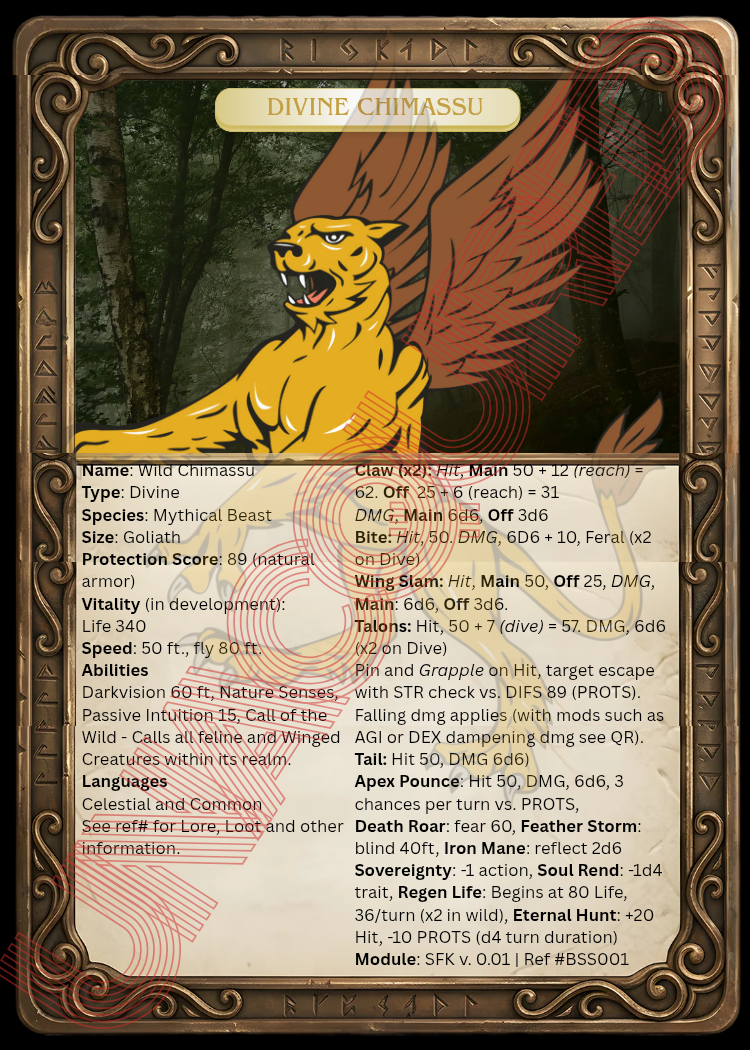
Divine Wild Chimassu, Boss Encounter Card
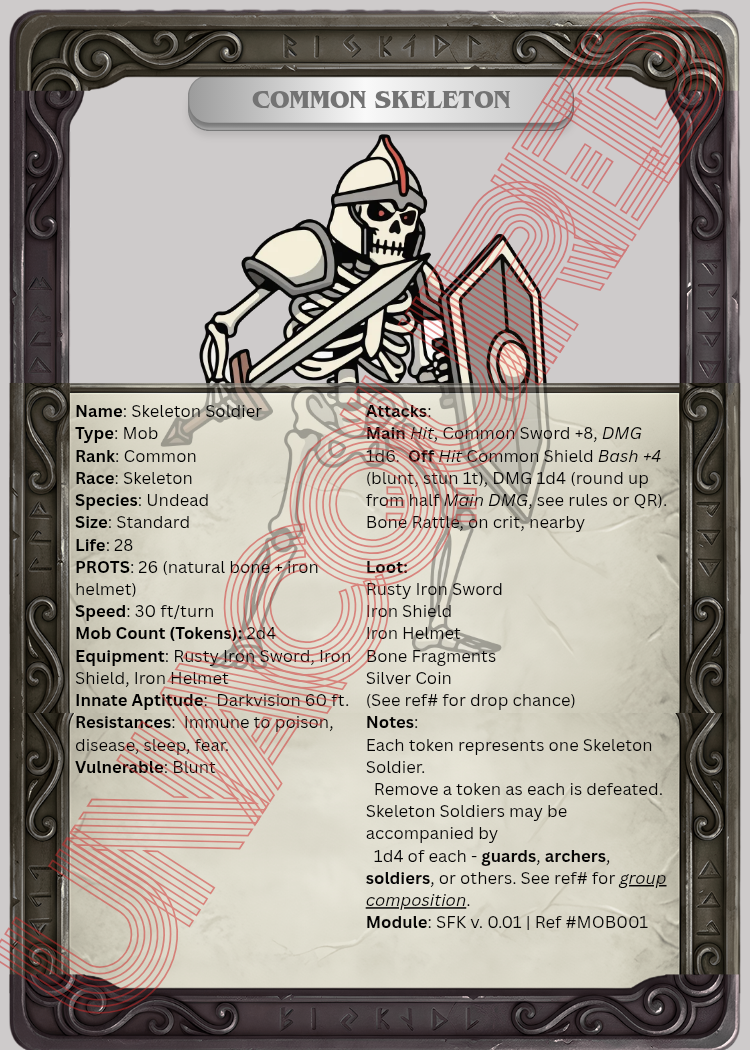
Common Skeleton Soldier, Mob Encounter Card
Companion Cards (Encounter)
Companions are; pets, guardians, angelics, fellowships (NPCs), temps (hirelings, summons etc.), drafts, ruminants, and mechanical. Mechanical companions are constructed companions with no biological needs. Subtypes include: Vehicular (remote-controlled or piloted machines that also serve as transport), Droids (autonomous task-built robots), Automatons (mechanical constructs, often arcane-powered), Androids (humanoid machines capable of social interaction), and Drones (small aerial or surveillance units). Mechanical companions follow the same bonding, upkeep, and mood rules as organic companions, but their upkeep consists of maintenance, charging, oil, and repair rather than food and rest. There are no Averse companion types; races have Favored companion categories that bond faster and cost less to maintain. Each Companion has its own Stats listed on their card. Stats can improve as the Companion advances through Performance Tiers, current stats are tracked in the Companion slot on the character sheet.
Characters have four Companion slots, one of each size: tiny, small, standard, and large/goliath/behemoth. The fourth slot is shared, a character may have a Large, Goliath-sized, or Behemoth-sized companion in this slot, but only one. Up to four Companions can accompany a character at one time. Tiny Companions are the smallest, typically insects, bugs, or very small creatures. Small Companions are roughly the size of a rodent or small bird. Standard Companions are humanoid-sized up to the size of a large horse or similar creature. Large Companions occupy 2x2 squares. Goliath Companions range from large humanoid-scaled creatures to the scale of a Centyr (4 spaces). Behemoths can reach colossal sizes and are extremely rare. Goliath-sized races can mount Large companions or anything larger (Large, Goliath, Behemoth). These allies support in combat, travel, and exploration, with Unique Abilities, adding depth to gameplay and character interactions. Each Companion Card may or may not be restricted to character class and race. If a Common or Uncommon Companion dies, the character loses them permanently, they cannot be resurrected and do not go to the boneyard.
Companion Names and Nicknames
Every Companion has a generic Name that describes what they are, for example, Moorback Goat. This name is fixed and comes with the Companion Card. Characters may give their Companion a Nickname of their choosing. Common and Uncommon Companions will respond to any nickname given. Companions of Rare rank and above already carry their own name and have their own identity, they may or may not accept a nickname given by the character. A Companion that does not accept a given nickname will not respond to it. Whether a Companion accepts a nickname is at GM discretion, including what roll to use and which dice. Fellowships, which are NPCs, always carry a name of their own and follow the same nickname rules, they may accept a nickname but will not respond if they do not. These naming rules do not apply to summons such as whistle-calls, scroll summons, or other temporary conjurations.
Summoning Companions
Companions can be summoned as long as the character has an open Companion slot of the appropriate size. Each Companion type has a corresponding summoning device, a whistle, an orb, a token, or a similar item listed on the Companion Card. The summoning device must be in the character's possession to call the Companion. Companions that are at a safe keep, in the wild, or roaming freely return when the device is used, provided they are within range (range listed on card). Companions that do not respond to a summoning call within the expected window may have wandered too far, been harmed, or are refusing due to low Mood, the GM determines what has occurred. Behemoths and Goliaths that were released into the wild (see Companion Movement) are automatically summoned when the character returns to the area and uses their device. Companions cannot be summoned into spaces smaller than their size category allows. A character without a summoning device cannot call their Companion remotely.
Common Companions are easier to acquire, but characters may develop bonds with their Companions, and may want to be careful with their lives, eventually providing them a safe keep, like a home. Common and Uncommon are the Companions that always come in box sets as punch out Cards. Companions of rank Rare and above can be resurrected the same way Characters can (see dying and death below). Until resurrected, passing Companions of Rare rank and above go to the boneyard. Upon resurrection, the Companion's mood resets to Annoyed, the lowest mood tier.
Companion Lifespans: Companion lifespans vary by rank. Common and Uncommon Companions have the shortest natural lifespans and cannot be resurrected upon death. Rare Companions live significantly longer, decades to centuries depending on their type. Epic Companions have extended lifespans measured in centuries. Legendary Companions may live for many centuries. Unique Companions are extraordinarily long-lived. Divine Companions are immortal and do not die of natural causes. Specific lifespans for each Companion are listed on their card.
Companions need rest, care, and proper nourishment. While they can survive without direct care, their performance is influenced by their overall condition. They have three tiers of performance: Basic, which provides standard capabilities; Intermediate (Int.), offering enhanced Abilities and resilience; and Advanced (Adv.), where the Companion reaches peak performance with maximum effectiveness in travel, combat, and support roles. A character's management and care determine which tier they operate in during their adventures.
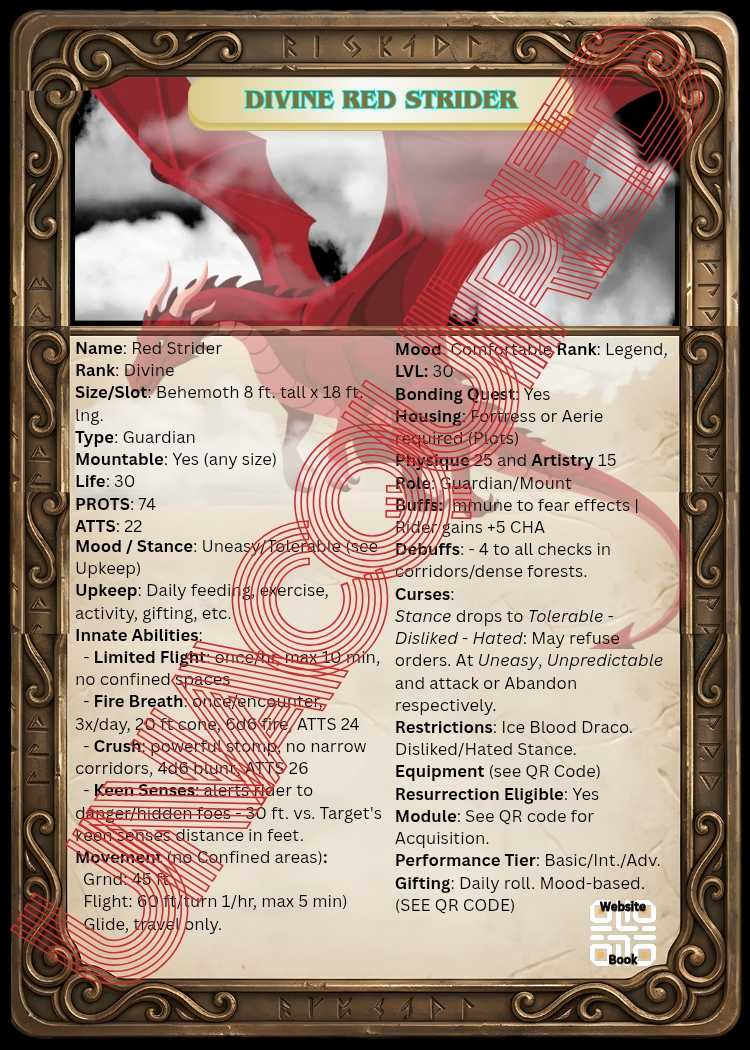
Divine Red Strider, Companion Card (Guardian)
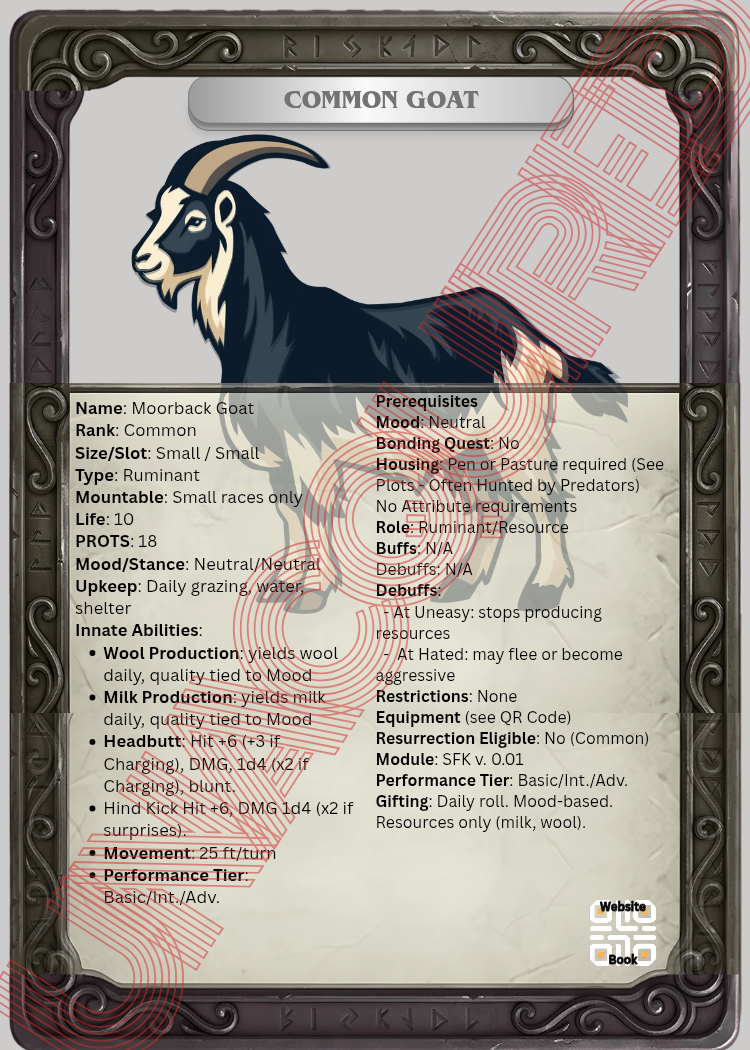
Common Moorback Goat, Companion Card (Ruminant)
Companion Vitality
Companions, Bosses, and Mobs only have Life vitality. They do not have Mana, Stamina, or Endurance and do not expend them. Only Life can be depleted. They also do not have Traits or Attributes, their Abilities are innate and built into their card, requiring no trait or attribute Prerequisites. What they have is: Life, Abilities, Armor, and Attacks.
Companion Ability Structure
Each Companion has one Primary Ability and one or more Secondary Abilities, all listed on their card.
The Primary Ability is the Companion's defining power, the single most impactful thing they do. It reflects their core nature: a guardian's devastating charge, a pet's unnerving distraction, a ruminant's moment of surprising defense. Every Companion has exactly one. Its value on the card is what scales with Performance Tier advancement.
Secondary Abilities are additional options available to the Companion in play. A Companion may have one or more depending on rank and type, Common and Uncommon Companions tend to have fewer; higher-rank Companions carry more. Secondary Ability values also improve as the Companion advances through Performance Tiers.
In combat, the player draws from the full set, Primary and Secondaries together, and selects which to use on their turn. Each Ability on the card has its own defined effect, range, and value. The Companion's hand is fixed, what is on the card is all that is available. This makes each Companion's combat role distinct, deliberate, and worth knowing well. Further information on each Companion's Abilities can be found in the module by referring to the mod-ref# on the card.
Companions fight on their owner's turn, controlled by the player, but they are not tools. Mood shapes everything. A Companion at high Mood is a willing, capable ally. One at low Mood is slow, reluctant, and unpredictable. At lower Mood tiers, a Companion may hesitate, act slowly, or ignore a command entirely, this is not a malfunction, it is their personality responding to how they have been treated. The Companion acts on the player's turn or as specified on their card.
Companion Mood
Companions track Mood, their current emotional and behavioral state. Mood is the primary relationship metric between a Companion and their owner, shaped by upkeep, gifting, care, time, and experience. It is tracked on the Companion Card and directly influences performance, buffs, and behavior in play.
Mood Scale: Annoyed, Distressed, Uneasy, Wary, Neutral, Content, Comfortable, Tranquil, Exalted. Annoyed is the lowest tier. Exalted is the highest and is reached only through a Bond Quest. Common and Uncommon Companions have no Bond Quest and cannot reach Exalted, their Mood caps at Tranquil.
Starting Mood: All Companions begin at Neutral when first acquired, regardless of rank or type.
Race Compatibility: Certain character races have a natural affinity with specific Companion types or races, bonding comes more naturally and Mood advances faster. Others may find the relationship slower to develop. Compatibility is noted on each Companion Card. Characters with a favorable racial pairing require fewer gifts and less time to advance Mood tiers. Incompatible pairings are not impossible, just slower. This reflects the natural dynamics between species across Essentia.
Mood Effects
Mood shapes every aspect of a Companion's behavior in play, combat performance, cooperation, resource output, and the bonuses they pass to their owner. A well-bonded Companion is a meaningful mechanical advantage and a narrative anchor. A neglected one becomes a liability.
| Mood | Effect | Example |
|---|---|---|
| Annoyed | -1 to all Companion Ability rolls. Stubborn and uncooperative, follows basic commands slowly and reluctantly. May wander off unnoticed during downtime at GM discretion. Does not attack the owner at this tier, just difficult. | A guardian that lags behind, snaps before obeying, or sits down mid-hunt. |
| Distressed | No bonuses. Companion is unreliable, GM may have them hesitate or act erratically. | A mount that keeps stopping, a ruminant that won't eat, a Droid that misfiles tasks repeatedly. |
| Uneasy | No bonuses. Companion follows orders without enthusiasm. | A pet that hides at the start of each session, reluctantly emerging when called. |
| Wary | No bonuses. Standard compliance, cautious. | A companion that stays close but offers nothing extra, present, but not engaged. |
| Neutral | Base performance. No bonuses or penalties. | Standard performance. The Companion does its job and nothing more. |
| Content | +1 to all Companion Ability rolls. Ruminants begin producing resources. | A guardian that greets its owner eagerly at camp, focused and ready. |
| Comfortable | +2 to all Companion Ability rolls. Companion begins gifting owner unsolicited items or resources daily (cap: 1d4/day). | A moorback goat leaves extra milk each morning without prompting. |
| Tranquil | +3 to all Companion Ability rolls. Owner gains +1 to all rolls while Companion is present in the same zone. Bond Quest becomes available for eligible Companions. | A war horse charges without hesitation, the steadiness of the bond bolstering its owner's resolve. |
| Exalted | +4 to all Companion Ability rolls. Owner gains +2 to all rolls while Companion is present. Exalted Ability unlocks, unique per Companion Card. Companion remains loyal even through mistreatment. The GM may issue an Exposed title to a character who abuses this loyalty, see Titles under Prestige. | A Bond Quest completed, years of trust built, the Companion acts as an extension of the character's will. Abilities available to no other version of that card become accessible. |
Mood Decline Resistance
Higher Mood tiers are harder to lose. The number of consecutive days of neglect required to drop one tier increases as Mood climbs. Neglect includes missed feedings, no exercise, no activity, untreated injuries, overwork, or prolonged absence without a caretaker.
| Tier | Consecutive days of neglect to drop one tier |
|---|---|
| Annoyed, Wary | 1 day |
| Neutral, Content | 2 days |
| Comfortable | 4 days |
| Tranquil | 7 days |
| Exalted | Cannot decline from neglect alone. Only sustained betrayal or abandonment, at GM discretion. |
Overworked: If a Companion is used beyond their daily action threshold (listed on their Companion Card), Mood drops 1 tier at the end of that day regardless of upkeep quality.
Bond Quests
Companions of Rare rank and above with Bond Quest eligibility (noted on their card) unlock a Bond Quest once their Mood reaches Tranquil. Bond Quests are module-driven, they are embedded in the module and tied to the specific Companion. The GM may create or alter Bond Quests for their campaign if they choose. Through a Bond Quest, the Companion's history, nature, and story unfold as the relationship deepens. Completing a Bond Quest is the only path to Exalted. Common and Uncommon Companions have no Bond Quest and cannot reach Exalted.
Upkeep
Companions require daily upkeep to maintain and improve Mood. Upkeep applies to all Companions as a group, they are managed as one unit, not individually. Upkeep needs vary by Companion type and are listed on each Companion Card. Companions in their Favored environment are self-sufficient, no upkeep is required while they remain in that environment. General upkeep categories include:
- Feeding: Organic Companions require appropriate food and water daily. Type and quantity are listed on the card. Mechanical Companions require charging, fuel, and consumable equivalents.
- Exercise and Activity: Companions need regular physical engagement suited to their type. Guardians and mounts need movement and stimulation. Ruminants need grazing and open space. Neglecting this causes Mood to decline.
- Rest: Companions need adequate rest between uses. Repeated overwork without rest triggers Mood decline regardless of other upkeep.
- Injury Care: Injured Companions left untreated decline in Mood each day until treated. Treatment type depends on the Companion, healing abilities, a vet NPC, or a repair station for Mechanical Companions.
- Presence: Some Companions are sensitive to their owner's absence. Extended time away, even with a caretaker, may cause Mood to decline past the Absence Threshold listed on the card.
Caretakers
When a character leaves a Companion at their safe keep, one or more caretakers are required to maintain upkeep. Caretakers can be family members, hirelings, or assigned NPCs. Caretaker quality determines how well upkeep is managed, a negligent or unskilled caretaker may let Mood slip even under otherwise stable conditions. The GM determines caretaker effectiveness based on who is assigned and how well they are supported.
Without a caretaker, Companions will leave. What happens to them after that is unknown, they may survive in the wild, be found by another, or simply disappear. If a Companion is locked up without a caretaker, they will die. The GM may issue an Exposed title to a character who abandons or locks up a Companion without care, see Titles under Prestige.
Even with a reliable caretaker, some Companions are sensitive to extended absence from their owner. Once the character has been away beyond the Companion's Absence Threshold (listed on their card), Mood begins to decline 1 tier per week regardless of caretaker quality. Upon return, the character must restore full upkeep and gift the Companion to rebuild Mood.
Gifting
Gifting is about discovery. No guide will say what a Companion wants, that is learned through time spent together. What they accept with enthusiasm, what they ignore, and what they refuse tells a character something about them. Give too much of one thing and they tire of it. Pay attention, and the bond deepens. Ignore it, and gifts become noise.
Characters can gift Companions to improve Mood. Gifting is capped at once per day per Companion. Mood progress accumulates over multiple days, it does not jump tiers immediately. The number of successful gifts required to advance a tier increases as Mood climbs.
Learning Preferences: A Companion's Preferred and Disliked gift categories are not revealed at acquisition, they must be discovered through experience. When a gift is accepted enthusiastically, the category is revealed as Preferred. When a gift is refused or ignored, the category may be Disliked. Players learn their Companion's tastes through trial over time. Some Companions are harder to read than others, the GM determines how quickly preferences become clear. For example: a common pet may have no obvious tell at first, but slip them a piece of sugar and they light up. Over time, the player confirms sugar (sweet treats) as a Preferred category. Try giving the same treat every single day and the effect diminishes, mix in other gifts to keep it meaningful.
Over-Gifting: Gifting the same category repeatedly in a short period reduces its effect and may eventually cause the Companion to lose interest. A Companion that receives the same type of gift too often may begin treating it as a Standard gift rather than Preferred, or stop responding to it entirely for a time. Variety is rewarded.
| Gift Type | Effect |
|---|---|
| Standard gift (not disliked, not over-used) | +1 Mood progress toward next tier |
| Preferred gift (discovered preference, not over-used) | +2 Mood progress toward next tier |
| Beloved gift (rare, meaningful, GM discretion) | Immediate +1 Mood tier |
| Disliked gift | No effect |
| Disliked gift repeatedly | May cause Mood to drop 1 tier at GM discretion |
| Over-gifted category | Effect reduced or lost temporarily, GM discretion |
At Comfortable Mood and above, Companions gift back, items, resources, or finds, rolled daily (cap: 1d4/day). Ruminants gift resources only (milk, wool, eggs). The quality and frequency of Companion gifts scales with Mood.
Companion Role
Each Companion Card lists a Role, the primary function the Companion serves. Role determines what duties the Companion can perform, how they contribute in and out of combat, and what upkeep they require. A Companion may have more than one Role.
- Guardian: Combat and protection. Fights alongside the character, defends the party, and can be mounted. Examples: wolf, warbear, trained cat.
- Mount: Travel and transport. Carries the character and their gear across terrain. Examples: horse, strider, Gryphlet.
- Ruminant/Resource: Passive resource production. Produces milk, wool, eggs, and similar outputs daily at Content Mood or above. Examples: moorback goat, sheep, laying hen.
- Draft/Labor: Hauling, plowing, and heavy work. Carries loads, pulls wagons, and supports the homestead. Examples: mule, ox, workhorse.
- Pet: Bonding and passive benefit. Provides Presence Bonus each year accompanied. Examples: cat, rat, barn owl, tiger.
- Angelic: Supernatural presence. Hovers at the character's shoulder. Provides Presence Bonus and unique Abilities tied to their alignment. Examples: Cherub, Imp, Wisp.
- Fellowship (NPC): Humanoid support. Can act as caretaker, caddy, and combat ally. Carries gear, manages inventory, and provides social presence.
- Temp: Temporary summoned or hired assistance. Useful for specific tasks or limited encounters. No long-term bonding or Mood system applies.
- Mechanical: Constructed task companion. Performs specific functions without biological needs. Examples: Droid (autonomous task-bot), Drone (aerial scout), Automaton (arcane construct), Android (social humanoid machine).
Ruminant Resource Production
Ruminants produce resources daily, milk, wool, eggs, and similar outputs, but only once their Mood reaches Content or above. They will not produce until they like their owner. The quality of resources scales with Mood: higher Mood yields higher quality output, affecting the value and effectiveness of crafted goods derived from them. Quantity and quality thresholds are listed on each Ruminant's Companion Card. Ruminants kept at a safe keep with a caretaker produce resources automatically each day provided their Mood is Content or above. When slain, Ruminants drop meat, hide or wool, and any items they may have consumed, drop chances are listed in the module.
Companion Ailments
A Companion Ailment is a temporary debuff the GM applies quietly after specific events, an injury not fully healed, an unsettling encounter, time in a hostile environment, or circumstances the character may not fully understand. Think of it like a cold: the Companion is simply off for a bit, a little slower, a little less accurate, a little more cautious than usual. The player notices the difference but may not know why. Ailments are not tied to Mood directly, but Mood influences how quickly they resolve: higher Mood helps them clear sooner, while declining Mood may let them linger. Ailments resolve on their own over time. The GM tracks them and determines when they lift, no action is required from the player unless the GM indicates otherwise.
Performance Tiers
Each Companion operates at one of three Performance Tiers, Basic, Intermediate (Int.), or Advanced (Adv.). As they advance, their stats improve. Current stats are recorded in the Companion slot on the character sheet and updated each time a tier is reached. Tier progression is determined by sustained Mood level and consistent upkeep over time, held at Comfortable or above long enough, a Companion naturally advances. Neglect pushes them back toward Basic. The GM tracks tier progression.
| Tier | Stats | Availability | Story Depth |
|---|---|---|---|
| Basic | Base values as printed on card | Standard. Responds when called. | Surface-level. Limited engagement before rest needed. |
| Intermediate (Int.) | +1 to Life, +1 to Primary Ability value | Increased. Longer engagement duration. | Personality and history begin to surface through interactions. |
| Advanced (Adv.) | +2 to Life, +2 to Primary Ability value, Secondary Ability values improve | Maximum. Extended engagement duration. | Full story depth accessible. Bond fully expressed. Companion feels truly alive. |
Companion Aging
Each Companion race has its own natural lifespan, noted on their Companion Card. It is rare to acquire a Companion with a shorter lifespan than the character's own, and many higher-rank Companions are immortal by nature. Aging is handled narratively rather than mechanically. The GM may introduce aging elements through roleplay, story events, or Bond Quests at their discretion.
When a Companion dies of natural causes, the character is expected to treat the passing ceremonially and respectfully. Failure to do so, dismissing the death, abandoning the body, or showing indifference, may cause the GM to issue an Exposed title reflecting the character's disrespect. See Titles under Prestige.
Companions of higher ranks are extraordinarily long-lived and will rarely die of old age during a character's lifetime. However, Companions may be passed down to family members across generations, a Companion bonded to a parent may outlive them and bond anew with their child. Players can take on these inherited roles in later sessions, beginning with an existing Companion and the history that comes with it.
Accompanying
At every long rest, the character decides which Companions accompany them. This decision determines which Companions are active, present, and counted toward all Mood, upkeep, environment, and presence bonus rules. Companions not chosen to accompany are left behind, at a safe keep with a caretaker, or released into appropriate care. The term "accompany" applies universally across all companion rules.
The Presence Bonus (see below) is lost if a Companion goes unaccompanied for more than 2 consecutive months. It rebuilds at the same rate, +1 to the associated Trait per year accompanied, once the Companion accompanies again.
Companion Presence Bonus
Each Companion grants +1 to a specific Trait per year they accompany the character. The Trait is unique to each Companion type and listed on their Companion Card. Not all Companions of the same category grant the same Trait, refer to the card. Examples:
| Companion | Type | Trait |
|---|---|---|
| Mule | Draft | Strength |
| Tiger | Pet | Agility |
| Moorback Goat | Ruminant | Constitution |
| Cherub | Angelic | Piety |
| War Horse | Guardian | Courage |
| Barn Owl | Pet | Vigilance |
| Droid | Mechanical | Focus |
Companion Environments
Each Companion Card lists Favored and Disliked environments. These reflect where the Companion thrives and where they struggle.
Disliked Environment: The character must actively compensate to keep the Companion functional. This costs 1 Endurance Chip from the character every 3 hours of in-game time. Mood also drops 1 tier every 3 hours the Companion remains in a disliked environment.
Favored Environment: The Companion sustains itself, no upkeep required while in a favored environment. Mood rises 1 tier passively every 3 hours. No additional actions are granted to the character from this.
Companion Tickets
Companions are acquired through Companion Tickets, items exclusive to the module in which they are found. A Companion Ticket's rank cannot exceed the rank of the module it dropped in, and cannot exceed the rank of the character who rolled it. Rank is determined at the point of the drop, at the boss itself, not the keeper. The boss may drop a Companion below its own rank. If the module ranks based on level, refer to the Module Rank by Level table in the previous section. Characters may hold tickets even when their Companion slots are full, they just cannot redeem them until a slot opens.
To redeem a ticket, the character brings it to the appropriate keeper, the ticket indicates what type of keeper is required. The character does not know which specific Companion they will receive until they roll at the keeper. The roll determines the Companion within the eligible pool for that ticket's rank and type. There is no fee to receive the Companion, it was earned on the drop roll.
Before redeeming, the character knows the Companion type and rank listed on the ticket. This allows tickets to be traded with other players before summoning. Characters may also turn a ticket in to a keeper in exchange for gold rather than redeeming it for a Companion.
How tickets drop: Guaranteed from module milestone completions. Boss encounters have a low chance to drop a ticket, the higher the module rank, the lower the drop chance. No tickets drop from standard encounters.
Companion Equipment and Gear
Companions can be equipped with gear appropriate to their type and size, harnesses, armor (barding), saddles, signal whistles, and more. All equipped gear is recorded in the Companion slot on the character sheet alongside current stats and nickname. Armor for Companions provides PROTS bonuses and varies by type: scale barding, hide wraps, plate barding, chain mail coverings, and more. Saddles improve rider comfort and stability, but custom or travel saddles increase travel duration. Signal whistles can be used to call a Companion home from a distance. Equipment for Companions is not included on the Companion Card by default, enter the green portion of the card's ref # at the website for available equipment and digital content.
Safe Keeps and Home Duties
Characters can provide their Companions with a safe keep at their home or property. Safe keep types vary by Companion: stables for mounts and drafts, kennels for pets and guardians, aviaries for flying Companions, enclosures for large or exotic creatures, and pens or pastures for ruminants and draft animals. Companions kept at home can be assigned duties during downtime, including guard duty, draft labor, ruminant resource production (milk, wool, eggs, etc.), and other roles suited to their type. Duties are determined by Companion type and the character's property setup.
A safe keep requires a keeper, a hired or assigned caretaker responsible for the Companions left behind. Without a keeper, Companions cannot simply be released or abandoned. If left without care and no way to leave, they will die. If left able to wander but without care, they will leave, and what becomes of them is unknown. Characters who abandon Companions without proper arrangements face consequences: alignment shifts, damaged standing with factions and higher powers, and potential Exposed titles issued by the GM. See Titles under Prestige. Failing to arrange a keeper means the Companion holds its slot, it is not free, and no new Companion can fill that slot until the situation is resolved.
Ruminants and other farm animals kept on a plot are vulnerable to predators, wolves, large birds of prey, and other wildlife may hunt them during the character's absence. Guardians assigned to the plot actively protect it and its animals from predators and other threats.
Companion Movement, Flight and Glide
Flying Companions have two distinct movement types. Flight is combat movement, measured in ft./turn and subject to the restrictions listed on the Companion Card. Glide is travel movement, used out of combat for long-distance travel, measured in travel time rather than ft./turn. Saddles may affect glide travel duration. Neither flight nor glide can be used in confined spaces unless the Companion Card states otherwise. Rider weight and gear affect travel range and speed during glide.
Behemoths and Goliaths in Confined Areas: Behemoth and Goliath Companions cannot enter areas smaller than their size category. When a character must enter a confined space their Behemoth or Goliath cannot follow, they may release the Companion into the wild temporarily. The Companion will survive on their own while the character is inside. When the character returns to the area, the Companion is automatically summoned, but only if the character has their summoning device. Without the device, the automatic summon does not occur and the Companion may have moved on. The character is at risk of losing the Companion permanently if they return without a summoning device and the Companion cannot be located. The GM determines the outcome.
Companion Prerequisites
Characters can only acquire Companions at or below their own rank, a character cannot receive a Companion of higher rank than themselves. This is the primary Prerequisite and is always enforced. Some Companions are additionally restricted by character class, race, or faction standing. A Companion with a faction restriction cannot be acquired or maintained by characters who hold Disliked or Hated standing with that faction.
When a character receives a Companion Ticket, the ticket displays the Companion type and rank. This information is visible before redemption, allowing the character to trade the ticket with another player or turn it in to a keeper for gold before summoning. Once summoned, the Companion is bound to that character.
Race and Companion Affinity: A character's race can influence how quickly Mood develops with certain Companion types. Some pairings are natural, bonding is faster and upkeep lighter. Others are friction-filled and slow. An Angelic that leans radiant, for example, would have a notably difficult time warming to an Orcling character. Affinity and incompatibility are noted on each Companion Card.
Hirelings can come in various forms, including squires, bodyguards, cartographers, experts, and henchmen.
Companion Variants
Companions come in many forms, each with unique roles, restrictions, and relationships. They provide support in combat, travel, and exploration, and many carry their own backstories and mission statements. See descriptions below.
- Pets (small or tiny): Rodents, mammals, marsupials, critters and bugs, etc. From most Rare to most Common.
- Guardians: Guardians can be hired by just about any character, but hirelings are not cheap, and expect pay per day. Guardians are like larger pets. Characters can mount them and they can fight by their owners' side. If they're not taken care of, they won't respond. Feed them.
- Angelics (hover): Small supernatural beings that hover at the character's shoulder, unnervingly close, as if always watching. Angelics span a wide spectrum from radiant to infernal, each with their own appearance, temperament, and alignment. Examples include Cherubs (small radiant winged figures, warm and protective), Imps (small shadowed creatures, mischievous and dark), Wisps (glowing ethereal spirits, neutral and mysterious), Spectrals (ghostly apparitions, cold and unsettling), and Seraphlets (fierce miniature warrior angels, lawful and intense). Many more exist across Essentia. Alignment of the Angelic typically reflects or complements the alignment of the character they bond with. Cannot be mounted.
- Fellowship (NPCs): Humanoid companions that accompany characters. They provide support and assistance, working closely with their bonded character as they face challenges and explore the game world. Fellowships can also serve as caretakers for other Companions in the character's absence, managing upkeep, feeding, and daily needs. They may additionally act as a caddy, carrying gear, managing inventory, and keeping the character organized during travel and downtime.
- Temps: Temps include summoned creatures, magic constructs, hirelings, or other temporary allies that assist the party for a limited time. They are versatile resources to support the party's needs during their adventures.
- Draft: Working animals and haulers, often used for hauling loads, plowing fields, or carrying supplies. They are the dependable animals that support daily life and labor, commonly kept on farms, homesteads, or in stables within a character's home or community.
- Ruminants: Animals like cows, sheep, or geese provide resources such as milk, wool, and eggs. Rumor has it, some geese lay golden eggs. Characters can raise and harvest these resources on their farms or homesteads. When slain, Ruminants drop meat, wool or fur, and skin. They may also drop items they have eaten, see the module for drop chances.
- Mechanical: Constructed companions with no biological needs. Subtypes include Vehicular, Droids, Automatons, Androids, and Drones. Upkeep consists of maintenance, charging, oil, and repair rather than food and rest.
Note: Different Companion types are restricted to specific classes, such as Warlocks and rangers respectively using summons and guardians. Scrolls or other magical methods may be used for temps, and hirelings may be rented from various hosts throughout the world. There are also vehicles in SORC, including ships of the sea and air, organic and mechanical, mundane and technologically advanced.
Mounting
Tiny Companions cannot be mounted by anyone. Small-sized races can mount any size except Tiny. Standard-sized races can mount anything above Small. Goliath-sized races can only mount Goliath or Behemoth Companions, these share the same Companion slot. Certain Companions cannot be mounted regardless of size, Angelics being one example. Whether a specific Companion is mountable is noted on their card.
Mounting a Companion significantly larger than the rider requires a Strength check. The GM sets the difficulty based on the size gap between rider and mount, a Small-sized rider mounting a Goliath-tier Companion will face a substantially harder check than a Standard rider mounting a standard mount. Failing the check means the rider cannot mount that Companion until their Strength improves sufficiently or they receive assistance. Success and failure thresholds are in the GM Codex.
Prize Cards
Prize Cards are physical SORC Cards that are not tied to any specific module or level. They are among the prizes that can be won through the SORC Beyond community program using Community Points, no cash required. Prize Cards may represent any category within the SORC Card system: Armaments, Companions, Special Items, Lore Cards, and more, and can range from Common to Divine in rank. Characters may only use Prize Cards at or equal to their own rank, a Heroic-rank character cannot use a Divine Prize Card in play. Prize Cards are digital-access versions only, no physical box set binding. Their ref # must be refreshed periodically to maintain digital access, enter the green portion at the website. Prize Cards are fully tradable.
Note: Prize Cards are not bound to a box set code and supplement a character's collection. A free PDF version of the game is available for those without a box set.
How to Read a Card
This section's rules are currently under development.
Appendix
Sentimental Damage Type Table
Each class has a defined damage type for the class line, each path has a damage type for the path line, and each branch has a damage type for the branch line. All three lines accrue independently, see Sentimental Value above for the full accrual rules. The complete table is listed on each class's entry (pg. 3). A consolidated version is provided here for reference.
Gear and Equipment
Equipment is categorized into utility gear (practical tools like backpacks and ropes), armaments (weapons and armor for combat), miscellaneous items (candles, relics, symbolic objects), and materials (raw resources for crafting and repairs). Characters' carrying capacity is determined by their Strength Trait, with encumbrance affecting their movement and combat Ability, exceeding capacity leads to incapacitation, while being within limits may impose Penalties.
Gear includes practical items made from natural or manufactured materials to aid exploration and survival, with their weight and storage limits determined by Strength. Items are everyday objects with cultural or narrative significance, such as holy water or heirlooms, and materials are raw components like metals or herbs used for crafting, repairing, or fulfilling quests.
Equipment can be acquired through purchase, crafting, discovery, or looting, and its condition, quality, and rank influence its effectiveness. Armaments, comprising weapons and armor, are essential for combat and can be customized or enhanced via techniques like reforging, upgrading, socketing, enchanting, and infusing. These modifications involve skilled craftsmen and carry risks, such as potential breakage or failure, but allow for powerful and personalized gear. Armor and weapons have various Attributes influenced by their materials, craftsmanship, condition, and magical enhancements, affecting both protection and mobility. Overall, this system encourages strategic management of gear and resources to optimize character performance and storytelling.
Refer back to; Armor Cards, Weapon Cards, and Item Cards above.
Armament Drops: When an armament is destroyed, it drops materials from its recipe at random. Drop amounts and chances vary, see the module for percentages. Sundering an armament yields a higher drop chance and recovers all recipe materials.
Adventuring Gear
The everyday practical tools covered under Gear above, cheap, mundane items every character carries alongside their armaments. Weight is listed for encumbrance purposes, see Encumbrance, pg. 5.
| Item | Cost | Weight | Notes |
|---|---|---|---|
| Backpack | 2 Gold | 5 lbs | Standard carrying capacity |
| Bedroll | 1 Gold | 7 lbs | |
| Belt Pouch | 5 Silver | 1 lb | |
| Blanket | 5 Silver | 3 lbs | |
| Candle | 1 Copper | Negligible | Burns 1 hour; dim light |
| Chalk (1 piece) | 1 Copper | Negligible | |
| Crowbar | 2 Gold | 5 lbs | |
| Fishing Tackle | 1 Gold | 4 lbs | |
| Flask or Tankard | 2 Copper | 1 lb | |
| Grappling Hook | 2 Gold | 4 lbs | |
| Hammer, Small | 1 Gold | 3 lbs | |
| Lantern | 5 Gold | 2 lbs | Bright light 30 ft.; burns 1 Oil Flask per 6 hours |
| Manacles | 2 Gold | 6 lbs | |
| Mirror, Steel | 5 Gold | 0.5 lb | |
| Oil Flask | 1 Silver | 1 lb | Fuels a lantern for 6 hours |
| Piton | 5 Copper | 0.25 lb | |
| Rations (1 day) | 5 Silver | 2 lbs | |
| Rope, Hempen (50 ft.) | 1 Gold | 10 lbs | |
| Rope, Silk (50 ft.) | 10 Gold | 5 lbs | |
| Sack | 1 Silver | 0.5 lb | |
| Sewing Needle | 5 Copper | Negligible | |
| Shovel | 2 Gold | 5 lbs | |
| Signal Whistle | 5 Copper | Negligible | |
| Tent, 2-person | 2 Gold | 20 lbs | |
| Tinderbox | 5 Silver | 1 lb | |
| Torch | 1 Copper | 1 lb | Bright light 20 ft.; burns 1 hour |
| Waterskin | 2 Silver | 5 lbs (full) | |
| Whetstone | 1 Silver | 1 lb |
Planetary Markets
Not every world shops the same way. Ignis and most other planets mint and trade in standard coinage, but Futurem, Omnè, and Tredici run on laser-secured credit systems and treat coins as worthless (see Currency System above), anything bought there is priced in Credits, not Gold, and the two are not interchangeable at any vendor. What's for sale also shifts with the world, a volcanic forge-world stocks heat-worked goods a crystal-scarred battlefield world never would, and vice versa. Characters whose background originates from one of these worlds may begin play with items from that world's table as their starting equipment, at the GM's discretion, the same way a character's backstory can grant them access to Omnè's TAW and TABA (see Alignment and Class Compatibility notes on Race, pg. 2). Characters whose race originates from Ignis, Omnè, or Tredici (see Playable Races, pg. 2) may draw their entire starting equipment loadout from that world's table below instead of Zailister's, at the GM's discretion.
Tech and Magic Across Essentia
Essentia is lit by two suns (see the Prologue and Into the Uncharted Worlds of Essentia). Adoria, the inner sun, emits magic along with her light, sorcery and steel thrive on the planets closest to her, Ignis through Zailister among them. Tawdry Dwarf, Adoria's dying twin, sustains the six outer, technologically advanced planets (Octavo, Angeligla, Corpus Caeleste, Undecimus, Omnè, and Tredici) on her fading light alone, magic never took root there, and technology filled the gap instead.
This split powers a reciprocal Penalty between TAW/TABA and magic, on top of the gravity and atmosphere range penalty already covered under TAW Shoot (Basic Rules pg. 5):
- TAW and TABA function at full strength on their native Tawdry Dwarf-lit worlds (Octavo, Angeligla, Corpus Caeleste, Undecimus, Omnè, Tredici), the baseline for both, no Bonus or Penalty. Venture beyond Tawdry Dwarf itself, into the uncharted worlds past Essentia's known thirteen planets, and TAW gains +2 Hit and +2 Damage while TABA gains +2 AS, technology's edge sharpening the further it gets from Adoria's magic entirely. On any of the first eight, Adoria-lit worlds, including Zailister, the most balanced of the thirteen planets between sorcery and technology, TAW instead suffers -2 Hit and -2 Damage and TABA instead suffers -2 AS.
- Magic and Spells function at full strength on Adoria-lit worlds. On Tawdry Dwarf-lit worlds and beyond Tawdry Dwarf alike, magic still works but suffers -2 to Spell Hit and potency, weaker there, never absent.
- Martial weapons and armor (mechanical, non-magic, non-TAW, non-TABA gear, ordinary steel and craft) function at full strength on both Adoria-lit and Tawdry Dwarf-lit worlds, untouched by either sun. Beyond Tawdry Dwarf, in the uncharted worlds past Essentia's known thirteen planets, Martial weapons and armor instead suffer -2 Hit and -2 Damage (weapons) or -2 AS (armor), only the sharpest technology holds up out there.
These Penalties and Bonuses stack with any others already listed on a weapon, armor, or Spell card, and apply regardless of which world a character's race or background originates from, it's the world the character is standing on, not the world they're from, that decides which sun is powering (or starving) their gear.
Zailister, The Free Market
Zailister is the starting world, diverse, free, and the universe's reserve currency hub, and its markets reflect that. Standard coinage only, but goods from every world pass through, including imported Omnè tech sold at a premium far from home. Below are early examples of the Standard and Advanced Kit split noted above, using Thief and Hacker as the first two Talent Trees itemized.
| Item | Cost | Notes |
|---|---|---|
| Thief's Kit, Traditional | 10 Gold | Lockpicks, tension wrench, wax impression block, muffled leather wraps |
| Thief's Kit, Advanced (Omnè import) | 140 Gold | Signal-spoofing lock bypass tool, keycard data-skimmer |
| Hacker's Kit, Traditional | 12 Gold | Rune-scraping tools, ward-reading lens, counter-sigil chalk, manipulates wards and sigil-locks in place of digital systems |
| Hacker's Kit, Advanced (Omnè import) | 160 Gold | Decryption rig and data pad |
| Low-Tier Personal Communicator (Omnè import) | 90 Gold | Static-choked and short-range this far from Omnè's networks, the cheapest, worst model still worth carrying |
Ignis, The Ashfield Camp
Ignis (Glacies et Ignis) is an elemental world of extreme heat, home to wandering fire elementals and golems as much as the primal, tribal peoples who settle its ash fields between them. Nothing sold here is refined, it is chipped, tanned, bound, and carved by hand, with ritual standing in for the forges and tools other worlds rely on. Priced in standard coinage.
| Item | Cost | Notes |
|---|---|---|
| Obsidian War Club (1H Melee) | 12 Gold | Chipped volcanic glass studs |
| Ember-Fang Spear (2H Melee) | 16 Gold | Fire-hardened shaft, obsidian-flake head |
| Ashhide Wrap (Light Armor) | 14 Gold | Soot-cured tanned hide |
| Bone Talisman of the Ember Kin | 5 Gold | Ritual charm, chanted over to ward off scorching wind |
| Cinder-Bound Torchstone | 6 Gold | A stone ritually bound to hold a living ember; relit by chant, not flint |
| Slag-Bone Pick | 5 Gold | Mining tool; tip carved from a fossilized elemental's remains |
| Cinder Hound Bone Whistle | 6 Gold | Calls a trained cinder hound, sold separately as a Companion |
| Ash-Cured Waterskin | 4 Silver | Hide skin treated in ash-lye against the heat |
| Cooling Root Poultice | 3 Silver | Chewed root paste; soothes burns |
| Soot-Woven Face Wrap | 2 Silver | Plain cloth wrap; keeps ash from the lungs |
| Obsidian Grinding Stone | 2 Silver | Sharpens blades on volcanic glass grit |
| Fire-Struck Kindling Bundle | 3 Copper | Ordinary tinder; no ritual needed |
| Pyronium Ingot | 150-300 Gold | See Earth Elements, Metals, pg. 4, for standard rates |
Omnè, The Circuit Exchange
Omnè is the most technologically advanced of the planets, an older human world that developed without relying on magic. Its markets deal exclusively in TAW, TABA, and synthetic goods, and coins are not accepted here, only Credits.
| Item | Cost | Notes |
|---|---|---|
| TAW Sidearm, Common | 180 Credits | |
| TAW Rifle, Common | 340 Credits | |
| TABA Light Suit | 260 Credits | |
| Micro-Drone Scout | 220 Credits | Palm-sized; scouts ahead and relays a live view |
| Grav-Stabilizer Boots | 150 Credits | Softens falls, steadies footing |
| Signal Beacon | 75 Credits | Transmits a distress or extraction call |
| Atmospheric Filter Mask | 90 Credits | Required for extended off-world travel |
| Insulated Tool Kit | 60 Credits | For Engineer and Tinker professions |
| Data Slate | 55 Credits | Records and stores notes digitally |
| Photon Torch | 40 Credits | Handheld, rechargeable light source |
| Nanoweave Bandage | 25 Credits | Self-sealing medical wrap |
| Charge Cell | 20 Credits | Powers TAW and Electric-type Non-Organics |
Tredici, Fracture Row
Tredici is a crystal-scarred world shaped by generations of conflict, its ground littered with old battlefields and growing crystal formations. Its markets cater to mercenaries and scavengers alike. Coins are not accepted here, only Credits.
| Item | Cost | Notes |
|---|---|---|
| Warscar Plate (Medium Armor) | 260 Credits | Forged from salvaged battlefield metal |
| Crystal-Edged Blade (1H Melee) | 200 Credits | |
| Resonance Buckler | 175 Credits | Small shield; hums when struck by magic |
| Crystal Growth Kit | 90 Credits | Seeds and slowly grows a weapon-grade shard over several days |
| Fracture Charge | 45 Credits | Thrown; shatters into crystal shrapnel on impact |
| Chasm-Fiber Rope | 35 Credits | Crystal-woven; resists cutting |
| War Ledger | 30 Credits | Records kills, bounties, and campaign history; used by mercenaries |
| Scarfield Poncho | 20 Credits | Worn by scavengers picking through old battlefields |
| Trench Rations | 15 Credits | Preserved, long-lasting battlefield food |
| Bonecrystal Whetstone | 15 Credits | Sharpens blades using ground battlefield crystal |
Enhancing and Modification Armaments
There are several methods of Enhancements and each uses a different process to apply. For instance, salvaging or sundering plate armor uses different techniques that require skills of a blacksmith, while unweaving or burning cloth requires the skills of a stitcher.
Enhancing Armaments is done in many ways, including:
- Combining
- Enchanting
- Inscribing (including colors)
- Modifying
- Nesting (lining)
- Reforging
- Resonating
- Socketing (placement of Jewels, Runes and more)
- Sundering (Armorer skill, extracts materials from Excellent armaments at rank equal to or above the armament's rank; see below)
- Upgrading (augmenting Armaments)
If armor is broken during enhancements, most of the materials drop and it can be reforged. Some easier than others so be careful, otherwise the Armor Card goes to the boneyard until it's reforged. All enhancements are lost upon armor breaking and the chance of it breaking increases with every enhancement.
For example, if a weapon has been upgraded to +3, the chance of upgrading it to +4 is lower than it was to reach +3. If the armor breaks while attempting a +4 upgrade, it is destroyed and sent to the boneyard, and most of its materials are harvested. The amount of mats harvested is random.
When the armor breaks, it loses all of its previous enhancements, such as socketed gems, upgrades and nested fur, and all the materials used to enhance it, such as the gem socketed, vanishes as well. The broken armor stays in the boneyard until all the necessary materials to reforge it have been gathered.
Sundering: Sundering is an Armorer skill that can only be performed on Excellent condition armaments. A successful Sunder extracts materials at a rank equal to or above the armament's rank, something standard salvaging does not guarantee. Sundering also has a chance to drop exclusive materials unavailable through any other means. These materials are typically valuable, light in weight, and used to modify or craft gear of that rank. See the GM Codex for Sunder success rates and material tables.
These techniques can only be done by craftsmen trained in Professions aligned with these skills. For instance, Upgrading requires a Blacksmith Proficient in the Upgrading process of the Armament. Crafting requires a recipe (and the proficiency in the respective profession), the materials and at least a makeshift workshop.
Weapon Mods
Weapon Mods are special upgrades that can be added to a character's weapons by NPCs or players with the right professions (like blacksmiths, alchemists, or engineers). Each mod gives a weapon an added effect, such as poison, extra impact, shock, or better aim. Only Rare weapons and above may be upgraded. The effect can happen once per the Weapon's Rank beginning at Rare, so a Rare could grant the Mod's effect once per round. Seek out specialists, or learn the techniques directly, to modify weapons and gain an edge in combat.
Weapon Mod Scaling: Whenever a weapon mod refers to x (for example, "+x d6 damage" or "x times per round"), use the weapon's rank to determine x. This value applies to both the maximum number of times a mod can trigger each round and any scaling for damage or effects. Refer to the table below:
| Weapon Rank | x Value (per round & scaling) |
Example Damage (+x d6) |
|---|---|---|
| Rare | 1 | +1d6 |
| Unique | 2 | +2d6 |
| Heroic | 3 | +3d6 |
| Elite | 4 | +4d6 |
| Legendary | 5 | +5d6 |
| Divine | 6 | +6d6 |
Reagents (1h blade and piercing)
- What it does: Adds a groove or reservoir to a blade or piercing weapon, letting it hold and deliver liquid reagents (poison, acid, disease, etc.) on hit.
- How to get it: Modified by a blacksmith, alchemist, or specialist NPC in towns or shady markets.
- Effect: When loaded with a reagent, deals +1d4 damage of the reagent’s type (poison, acid, etc.) on a successful hit. Each application lasts 3 attacks before needing to be reapplied.
- How to use: Applying a reagent takes ½ turn in combat, or can be done outside of combat before the first attack.
Weighted Head (1h blunt)
- What it does: Adds a dense metal cap or spikes to a mace or club, increasing impact and chance to stun.
- How to get it: Installed by a blacksmith or weapon crafter in town.
- Effect: Deals +1d4 bludgeoning damage on hit. On a natural attack roll of 19-20, the target must make a saving throw or be stunned for 1 round.
Shock Coil Adapter (2h melee)
- What it does: A modular adapter affixed to the pommel (bottom) of a two-handed weapon. When the wielder successfully parries an attack, the adapter delivers a powerful shock to the attacker.
- How to get it: Crafted and installed by an engineer or tinkerer in a workshop or guild, requiring specialized tools and materials.
-
Effect: When the wielder successfully parries an attack (see trait Defense) the attacker takes +xd6 shock damage; where x is the weapon's rank (see table below). Rolling a natural 1 (or as per GM rules), the attacker is also stunned for x rounds. The adapter can only trigger once per rank per round.
Reminder: Only Rare weapons and above are qualified for Mods. This means a Rare weapon would have one Shock per round, while a Unique (the next rank up) weapon could have two shocks per round, and a Divine could have 6 (Divine always gets the effect on a miss).
| Weapon Rank | Shock Damage (per parry) | Max Shocks / Round | Stun Duration (on crit fail) |
|---|---|---|---|
| Rare | 1d6 | 1 | 1 round |
| Unique | 2d6 | 2 | 2 rounds |
| Heroic | 3d6 | 3 | 3 rounds |
| Elite | 4d6 | 4 | 4 rounds |
| Legendary | 5d6 | 5 | 5 rounds |
| Divine | 6d6 (also triggers on miss) | 6 | 6 rounds |
Reagent Ammo (1h ranged)
- What it does: Allows arrows or bullets to be dipped into reagents for extra effects.
- How to get it: Modified by an alchemist or fletcher (arrow maker).
- Effect: When loaded with a reagent, attacks deal +1d4 damage of the reagent’s type (poison, acid, etc.) on a successful hit. Each application lasts for 3 shots before needing to be reapplied.
- How to use: Applying a reagent to ammo takes ½ turn in combat, or can be done outside of combat before the first shot.
Scope (2h ranged)
- What it does: Adds a lens or tube to a bow or rifle for improved aim.
- How to get it: Installed by a glassworker or engineer at a city shop.
- Effect: Gain advantage (or +2 bonus, depending on the system) on ranged attack rolls made at long range.
Refinement and Mining (Armorer Tree) Rules
Rule: When a character mines ore, they roll a d100 and add their Mining Bonus (if they've learned the Mining Skill under the Armorer Profession Tree). The total determines the refinement yield percentage based on the table below. The value of the raw ore is a fixed base amount specific to each ore type per ounce, multiplied by the weight in ounces and the yield percentage to determine the final value of the ore.
The final ore value = Raw ore base value per ounce × Weight in ounces × Refinement yield percentage
This process models the quality and efficiency of extraction, with higher rolls indicating better yields.
Refinement Yield Table
| Roll Range (d100 + Bonus) | Purity Percentage | Description |
|---|---|---|
| 1 - 50 | 20% | Low purity, rough or unrefined gemstone |
| 51 - 70 | 50% | Moderate purity, semi-refined gemstone |
| 71 - 85 | 70% | Good purity, refined gemstone |
| 86 - 99 | 85% | Very high purity, near-flawless gemstone |
| 100 | 100% | Flawless or divine-quality gemstone |
Raw Ore Base Values (per ounce)
| Ore Type | Base Value per Ounce (Gold) |
|---|---|
| Pyronium | 1 |
| Quantite | 2 |
| Iridium | 1 |
| Orichalcum | 2 |
| Aetherium | 3 |
| Mithril | 2 |
| Dragon Scale | 4 |
| Vibranium | 5 |
| Eldritch Obsidian | 3 |
| Celestial Bronze | 4 |
| Starmetal | 4 |
| Titanium | 4 |
| Osmium | 6 |
| Tungsten | 4 |
| Ruthenium | 4 |
| Chromium | 4 |
| Steel | 2 |
| Inconel | 4 |
| Magnesium (Hadfield) | 4 |
Earth Elements, Gems
Gem Purity and Quality
Gems can vary in purity and quality, which affects their value and magical potency. The purity percentage indicates how refined or flawless the gem is, influencing its base value and enchantment capabilities. Higher purity gems are more valuable and more effective in magical applications.
Gem Purity Roll Bonus
When mining or crafting gems, a character rolls a d100 and adds their Mining Bonus to determine the final quality and value of the gem. The total roll, combined with the gem's inherent purity percentage, influences the final worth and effectiveness of the gemstone. A higher roll plus bonus results in a better-quality gem, which can lead to higher value or more potent enchantments.
| Roll Range (d100 + Bonus) | Purity Percentage | Description |
|---|---|---|
| 1 - 50 | 20% | Low purity, rough or unrefined gemstone |
| 51 - 70 | 50% | Moderate purity, semi-refined gemstone |
| 71 - 85 | 70% | Good purity, refined gemstone |
| 86 - 99 | 85% | Very high purity, near-flawless gemstone |
| 100 | 100% | Flawless or divine-quality gemstone |
Gem Base Value per Carat
The base value of a gem depends on its quality, size, and rarity. The value per carat is used to calculate the total worth based on the gem's weight. Higher quality gems or those with higher purity typically fetch higher prices. These base prices serve as a starting point for valuing gemstones in trade, crafting, or enchantment purposes.
| Gem | Base Price (Gold) |
|---|---|
| Diamond | 100 |
| Sapphire | 50 |
| Ruby | 60 |
| Emerald | 50 |
| Topaz | 30 |
| Amethyst | 35 |
| Obsidian | 10 |
| Garnet | 25 |
| Citrine | 20 |
| Nyxium | 150 |
| Infernium | 150 |
| Aetherstone | 200 |
| Moonstone | 150 |
Earth Elements, Metals
Metals are foundational materials throughout Essentia, valued for strength, versatility, and magical conductivity.
| Metal | Harvesting Technique | Value | Power | Drop on Failed Modification |
|---|---|---|---|---|
| Pyronium | Extracted from magma flows | 150-300 Gold/ingot | Fire-resistant; ideal for heat-resistant weapons and armor | Pyronium scrap |
| Quantite | Harvested from interstellar dust fields | 300-600 Gold/ingot | Extremely valuable; used in advanced crafting and technology | Quantite scrap |
| Lead Alloy | Standard smelting | 1-5 Gold/ingot | Blocks magical detection; used in anti-magic containers | , |
| Iridium | Found in meteorite fragments | 150-250 Gold/ingot | Resists magical and elemental damage; used in legendary items | , |
| Orichalcum | Smelted from rare enchanted ore | 250-400 Gold/ingot | Greatly boosts enchantments and elemental affinity | , |
| Aetherium | Synthesized in magical laboratories | 400-800 Gold/ingot | Source of immense energy; powers world-altering devices | , |
Fuel Elements
Raw and refined materials that power Non-Organic beings, vehicles, and machinery, mined, distilled, or charged depending on the source.
| Material | Harvesting Technique | Value | Power | Drop on Failed Modification |
|---|---|---|---|---|
| Coal | Mined from underground seams | 1-3 Gold/lb. | Burns to power steam engines and basic mechanical vehicles | Coal dust |
| Natural Gas | Vented from underground pockets, refined and pressurized | 5-10 Gold/canister | Powers gas lanterns, engines, and pressure-driven tools | Gas residue |
| Galvanic Cell | Assembled from conductive metals and acid | 10-20 Gold/cell | Stores and discharges electric current; powers Droids, Robots, and electric vehicles | Galvanic scrap |
Photon Core, Quantum Alloy, and Aetherium (Sci-Tech Elements and Earth Elements, Metals) also serve as power sources for Photon, Quantum, and Magic-powered Non-Organics, respectively.
Organic Elements
Harvested from creatures, essential for rituals, enchantments, and alchemy. The following elements have spell, potion, and/or scroll versions. When these materials are used to cast, Mana is not consumed.
| Reagent / Organic Element | Value | Notes |
|---|---|---|
| Bone Dust | 1 - 3 Gold /gm. | Common reagent, used in necromancy and curses. |
| Bat Wings | 5 - 10 Gold /gm. | Rare, used for flight, invisibility, and rituals. |
| Elderwood Ash | 2 - 4 Gold /gm. | Moderate rarity, channels ancestral energies. |
| Fairy Wings | 5 - 10 Gold /gm. | Delicate, used in enchantments and illusions. |
| Reptilian Tail | 3 - 6 Gold /gm. | Used for regeneration potions or curses. |
| Beast Blood | 4 - 8 Gold /gm. | Enhances strength and resilience. |
| Star Crystals | 10 - 20 Gold /gm. | Used to invoke divine or celestial effects. |
| Moonflower Petals | 5 - 10 Gold /gm. | Harvested at night, used in invisibility potions. |
| Luckstone | 3 - 7 Gold /gm. | Gives +1 to +3 chance, used in luck-based rituals. |
| Blessed Alloy | 50 - 100 Gold /gm. | Rare, used in high-level crafting. |
| Alicorn Dust | 50+ Gold /gm. | From shedded unicorns' Alicorns, extremely rare. |
| Dragon Ichor | 100+ Gold /oz. | From dragon-type creatures, effects depend on dragon type, extremely rare. |
Sci-Tech Elements
Advanced sci-tech materials mined, synthesized, or infused through high-energy and arcane processes. Form the building blocks of data chips, starship components, energy sources, and high-tech weaponry.
| Material | Harvesting Technique | Value | Power | Drop on Failed Modification |
|---|---|---|---|---|
| Plasma Crystal | Extracted from stellar plasma fields | 50 Gold/core | High-energy plasma source for starship engines and plasma weaponry | Plasma shard |
| Laser Crystal | Mined from asteroid belts; refined with high-energy alchemy | 30 Gold/crystal | Focuses and amplifies laser beams for weapons or cutting tools | Laser shard |
| Quantum Alloy | High-energy alchemical synthesis of rare space minerals | 75 Gold/batch | Crafts advanced circuit boards, processors, and energy conduits | Quantum alloy scrap |
| Photon Core | Photonic energy condensates with rare crystalline materials | 40 Gold/core | Energy source for photon-based weapons and propulsion systems | Photon shard |
| Dark Matter Infused Ore | Collected from cosmic dark matter reservoirs via ancient alchemy | 100 Gold/infusion | Reinforces armor and weapons; grants dark energy amplification | Dark matter fragment |
| Cryo-Exotic Alloy | Smelted from space metals infused with cryogenic magic | 35 Gold/ingot | Crafts heat- and cold-resistant plasma weapons and armor | Cryo alloy scrap |
| Starsteel | Forged from space minerals fused with cosmic energy | 45 Gold/ingot | Lightweight, ultra-strong material for starship hulls, weapons, and armor | Starsteel fragment |
| Synthetic Fiber | Nano-engineered polymers infused with magic for durability | 10 Gold/roll | Used in flexible stealth suits, armor, and high-tech gear | Synthetic fiber shard |
| Energy Conduit | Conductive crystalline materials infused with plasma and arcane energy | 25 Gold/unit | Facilitates high-capacity energy transfer in ships and weapons | Conduit fragment |
| Nano-Infused Crystal | Crystals infused with nano-machines and arcane energy | 60 Gold/crystal | Creates self-repairing technology or enhanced energy storage | Nano crystal shard |
| Voidstone | Mined from shadowed cosmic voids; infused with dark magic | 80 Gold/stone | Manipulates space, teleportation, or shadow energy | Void shard |
| Stingers | Found on Futurem, Omne, and Tredici | , | Shimmering metallic purple hue; lattice structure makes it incredibly strong yet lightweight. Essential for advanced technology and spacecraft construction. | , |
Prism Elements
Captured when a creature is slain by an attack, spell, or effect linked to the Soul Prism, or when a soul-binding ritual is completed. Used in advanced rituals and enchanted crafting.
| Prism | Harvesting Technique | Value | Power |
|---|---|---|---|
| Light Prism | Forged from pure light-infused minerals | 60 Gold/prism | Focuses and refracts pure light or magical energies. Illuminates dark areas; may project illusions. |
| Ethereal Prism | Made from rare spirit shards found in the spirit realm | 200 Gold/shard | Captures or interacts with spiritual entities; used in communication with spirits or teleportation. |
| Void Prism | Crafted from shadow-infused obsidian and voidstone | 300 Gold/prism | Manipulates void or null energies; used for banishment or containment of evil entities. |
| Elemental Prism | Made with materials representing fire, water, earth, and air | 100 Gold/prism | Capable of creating gentle elemental activity. |
Trials of Combat Currency
The Trials of Combat are competitions where adventurers face battles and challenges to earn points and rewards. Led by Field Marshalls, participants can earn Honor, Valor, and Auctorati Points, which are spent on gear, potions, and knowledge. The trials include arenas, coliseums, and strategic objectives, emphasizing skill and teamwork for powerful rewards and reputation.
| Currency | Earned In | Spent On |
|---|---|---|
| Trial Coins | Combat trials | Trial vendor items only; not used in general transactions |
| Honor Points | Proving Grounds | Exclusive gear sets and enhancements for trial challenges |
| Valor Points | Arena | Formidable weaponry, protective gear, and combat consumables |
| Auctorati Points | Coliseum | Dangerous armament sets, ancient potions, scrolls of forgotten knowledge |
Mapping
Module based adventures are unique campaigns where the worlds of SORC change at a party's hands and desires. Continue campaigns that ended with periodic expansions.
This map system is designed to allow parties near one another to communicate with each other as long as they've uploaded their location(s) to our servers, and have an available means to reach one another. One way, for instance, would be a soldier class's Tactic for "call to arms," a Warrior's "regroup" Tactic or a scout's, from the vocational tree Scout's Tactic, "call forth," which isn't as powerful as "call to arms," by default but serves a similar purpose. Players of other parties will have to accept the attempt to call them, as GMs communicate with one another.
Various sizes and designs of graph paper will be used to coordinate movement, combat and traveling. See the three sections on combat, movement and traveling below for more on this.
Reading the Map
The universe, Essentia. Maps are designed to display key areas that players will step into during their adventures in this geological order from largest to smallest: Planet, Continent, Region, Territory, Area and Space.
| Scale | Example | Description |
|---|---|---|
| Planet | Zailister | Large, round celestial bodies that orbit a star, shine by reflecting light, and have cleared their orbital path of other debris. |
| Continent | Nivis | Sovereign masses of land that contain all the following below. |
| Region | Shadowfen | Large areas that divide continents. |
| Territory | The Pearl Coast | Large areas of regions, such as settlements and even metropoli. |
| Area | Ase's Crypt (pyramid) | Places within a character's view. |
| Space | The elevator | Structures and small areas within the character's reach. |
Time
Essentia measures its years in Eons of Adoria (EA), the current year is 10,023 EA. Below that, the calendar runs on a simpler, table-friendly structure.
The Calendar
1 Eon of Adoria (1 EA) is 360 days, divided into 12 months of 30 days each. Turns and Rounds (see Turns, Rounds and Time, pg. 5) measure combat within a single day; the calendar measures everything beyond it, travel, downtime, seasons, and a character's life itself. This calendar is Zailister's own, every world of Essentia keeps its own seasons, and a planet's climate and light cycle (see each world's entry under Planetary Markets and Into the Uncharted Worlds of Essentia) do not necessarily follow Zailister's 4-season, 12-month pattern at all.
Zailister divides its year into 4 seasons of 3 months each, and marks the turning point of each with a festival, 8 in total spaced 45 days apart: Emberturn opens the year at the winter solstice, followed by Firstlight, Bloomrise (spring equinox), Sunwake, Highsun (summer solstice), Goldfall, Duskbalance (autumn equinox), and The Umbral Vigil, which closes the cycle back toward Emberturn (see Festivals & Seasonal Events, Zail pg. 1). These festivals are cultural observances, not the basis of the calendar itself, the day/month/year count above holds regardless of what is or isn't being celebrated.
Mortality, Immortality, and Retirement
Time is what eventually catches up with every character. Mortal races age against their natural lifespan (see each race's Lifespan tag); Immortal races don't, but every character still retires. Starting Age scales with a race's natural maturity, a quarter of their natural lifespan, or an effective 400 years for Immortal races, while the adventuring window itself stays the same 40 years for every race, so Retirement Age is simply Starting Age plus 40 (see each race's entry, pg. 2, and Retirement under Leveling and Advancement, pg. 2). Players choose their character's actual Starting Age from a short range at creation rather than a single fixed number, see Age under Character Creation, pg. 2. A character's Rank at that moment decides what's left behind: reach Legend and the world remembers the character in monuments, statues, and songs; retire below it and the recognition is quieter. See Legacy under Prestige, pg. 2, for how this same legend-building plays out in Prestige while a character is still active.